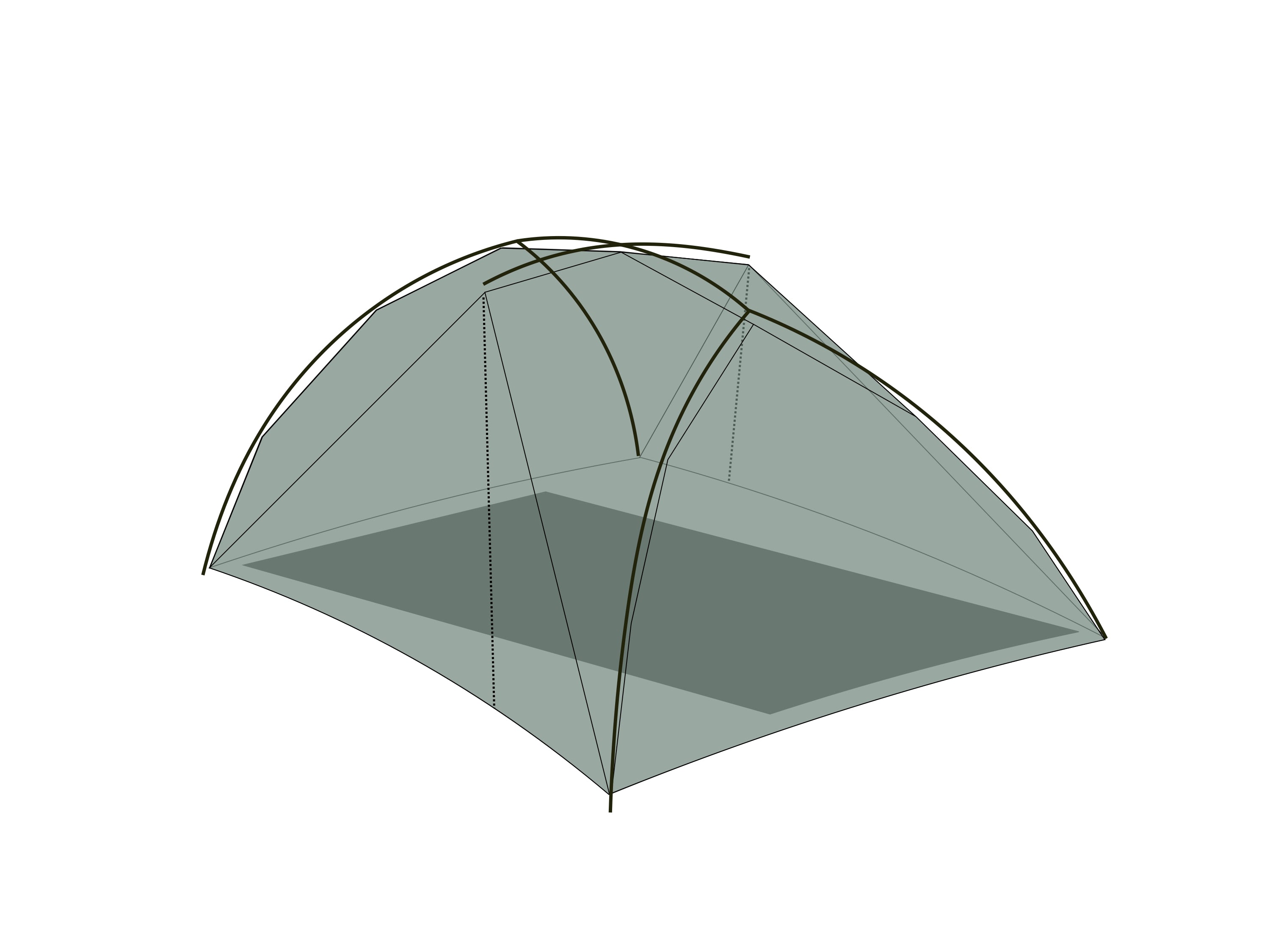
The X-Dome 2 really is quite spacious for a 2P tent. The floor looks like a good size, but what really makes it spacious is how the end walls and side walls are all so vertical, whereas most tents slope in a lot. Plus it is quite tall so even when you sit on a thick pad you aren't hitting the roof.
Compared to those 3P tents, would have a larger floor area but they are all shorter inside, and the Triple Rainbow and Dagger definately slope in quite a bit more on the sides. Actual interior volume is roughly similar to the TR and Dagger. The Hubba Hubba 3P would be larger.
With an ultralight tent there is more skill involved to push it into rougher conditions. If you apply skill, such as using guylines and the optional trekking pole supports, then you can push it into quite high winds. But if it is pitched without that, and perhaps poorly, that it will have lower limits of course.
It is a backpacking tent, so it is not intended for severe mountain conditions, but when used properly it should be able to handle everything within the reasonable scope of backpacking. We have seen it hold up to about 100 km an hour winds, when used with skill. I wouldn’t recommend taking it out in those conditions at all because winds near that are quite sketchy and you should be choosing a sheltered site if it is windy like that. But when you properly it can pretty reasonably handle pretty substantial winds
The ‘solid’ inners for our X-Mid have a panel of mesh (on the upper part of the doors) that can’t close, but with the X-Dome this mesh panel is accompanied by a second layer of solid material that can be closed to have it ‘full’ solid (no areas of exposed mesh).
I don’t have a great photo of it, but [this shot](https://durstongear.com/cdn/shop/files/16_-_Durston_X-Dome_2_Ultraight_Tent_-_Solid_Inner_446.jpg?v=1757631867) shows it when the solid layer is shut behind the mesh
The short answer is that it is a combination of sewn on and zippers, and is included in the weight.
The long answer is that the ‘flap’ of solid fabric is a triangle that is sewn along the bottom edge (permanently attached & part of the weight). So the bottom edge is ‘sealed’ such that any snow building up on the solid panel isn’t going to slide down into the tent.
Then the other two sides are both sewn for the lowest 4-5” to further prevent wind blown snow from sneaking in, and this creates a pocket that the rest of the flap can be tucked into when it is open.
Then above that, the side of the triangle along the main zipper has a zipper to zip shut. The zipper is not vertical, but angling over the flap, so it does a nice job of raising up the flap to cover the mesh. Operating the zipper is what closes the flap.
As it does that, the final side near the top is pulled closed and sits shut with a bit of overlap. It is an overlap closure for the upper part of the ‘top’ side, such that the mesh is covered but the edge here is not ‘sealed’. We could’ve put another zipper here (or Velcro etc) but it’s at the top, sits shut nicely now, and is shielded by the fly. If it’s so windy it’s forcing snow through there, it’s probably not the right conditions for this tent anyways, but if a user wanted it would be easy to add a bit of velcro
In terms of critiques, it's already been mentioned that light/ultralight shelters in general have less durable materials than traditional tents, so the X-Dome is comparable to it's peers in material durability, but less so than a heavier traditional tent.
For X-Dome specific critiques, I think the 3 main ones are:
**1)** Some people prefer a natural inner first pitch. I am a passionate advocate for a fly first pitch because it keeps the interior dry during setup in the rain, and then it is possible to pitch inner first/inner only but it is not quite as easy. There are some people who prefer the opposite because they mostly hike in good weather and usually do an inner only pitch, so this inner only pitch is a higher priority than a fly first pitch. The X-Dome works for that, but it's not as easy because we prioritize function in rough weather.
**2)** The footprint is larger than small 1P tents. The X-Dome 1+ footprint is not large for the amount of space it provides, but since it is essentially a 1.5P tent it does take up more real estate that a relatively small 1P tent like a Nemo Hornet. I think the footprint is still a reasonable size and the occasionally minor inconvenience of a larger footprint is worth it for more living space, but others will disagree.
**3)** It's not that light. The X-Dome is as light as it gets for a doublewall, nicely sized, freestanding tent (no other freestanding doublewall tent of comparable size is lighter), but there are tents that are lighter because they are smaller and/or semi-freestanding tent (e.g. Tigerwall). If you don't value the space and freestanding then a lighter tent may look appealing.
The X-Dome has more “controlled variables” so there is less to go wrong (less skill/practice). It is not necessarily faster because you still have to connect everything together, but there is less skill/technique.
So in skilled hands the X-Mid can be faster, while the X-Dome is more predictable and may be faster in less skilled hands.
The main thing is that you would be able to push it into higher winds before you would need to add the trekking pole supports.
As we showed in our wind tunnel video, the current structure can handle over 110 km/h (70 mph) winds and still looked fine at that point, so I wouldn’t be surprised if the current structure could go to about 130 km/h with the trekking pole supports.
But without them, the limit is substantially lower.
I like this approach because you are using skill and multi use to push gear into higher limits, rather than adding weight, but once we are talking about a true four season rated tent than it is nice to have it “just work” and have less dependencies.
So a stronger structure would let you go quite a bit higher winds without the extra support.
Yes. The issue is she is asking the wrong question which should be about reasonable in price and should include her pitching preferences. I use a Dyneema tent and would not recommend the expense to her.
In the other hand, something like a Durston XDome might work for her. That would be reasonable in price, less than a Big Agnes tent, and would weigh in a lighter ballpark than what she now uses.
I wish her luck, but agree she probably does not want a near a thousand dollar tent for three made of Dyneema for what she is doing.
REI is a good start for looking around. They will let her set up 2-3 tents side by side and crawl in and out of them.
The Durston 2p will actually fit two people. The other tents are ok for 2p for a weekend or a week but will get to feeling crowded after a while.
I mean I loved my Copper Spur but after a month or two in the Appalachian Trail my wife and I were always looking for an excuse to sleep somewhere else.
That said, if this is your first, I would seriously look at less expensive options like Lanshan and similar choices and look at hiking pole tents.
Freestanding tents are nice but you will find that they set up better when fully pitched out. Eventually it turns out that with a little experience that a trekking pole tent sets up just as fast but weighs less and costs less.
In my experience with multiple tents, at about 1200 miles you will have zipper issues. Either you crimp the zippers back down or replace them (zpacks sells replacements and now ships their tents with a set. Durston is planning on phasing that in too).
On the Appalachian Trail it isn’t as bad but the deserts and sand are just rough.
The X Dome is extremely robust when pitched correctly.
Very few users will be better served with the solid tent. Unless you only camp in very cool weather you want the regular X Dome.
You should be worried about the warm weather if you get the solid. The X Dome design is revolutionary because you can fold the fly back however you like to let air through the netting.
There's a decent argument that if you need the solid you should probably just buy a single wall 4 season tent. The solid is kind of a 3+ season tent that you lose a lot of functionality in warmer temps.
Look on Durston's website.... the 15th X Dome 2 picture is the "regular" with the bug screen and the 16th photo is the "solid."
Thx. I’ve owned an x mid2 for a couple seasons and love it, but I need a freestanding shelter for a canyoneering trip in Utah. Decided to give durston another shot and went with the XDome 2
Just purchased it! Seems like a no brainer, given the alternatives. I already own an xmid2 and love it but I’m planning a canyoneering trip to Utah and need something freestanding. Psyched to get the XDome out there and happy to support this Canadian company!
Thats true, cheap tents waterproofing doesn’t hold up to extended periods of rain, but a good tent might go 10 years or more. REI has the Mountainsmith Cottonwood 6p for $220 in their outlet which means you can get an additional 20% off if you are a member. That a great price at $176, and much better then a Coleman in terms of quality (good waterproofing and aluminum poles). Then you can get a higher end backpacking tent for yourself. The Nemo Dragonfly mentioned earlier is 30% off at several online retailers. 3P is plenty of room for two adults, though I’d still get the 2p and make your friends get their own tent. Or for a little more money get the Durston X Dome 2P w/ Aluminum poles.
The X-Dome is commonly recommended because it’s the lightest freestanding tent on the market when equipped with the carbon poles while still being spacious. Their 2P actually fits two, so you’d have to compare that with many other 3P tents which makes the weight really stand out. Personally I’m not a fan of Carbon poles as they seem more fragile than aluminum and am ok with a little extra weight. Fortunately Durston sells the tent with aluminum poles now. The 2p is still about 6-7oz lighter then the Nemo Dragonfly 3P with aluminum poles but a bit more expensive then the current sale price of the Dragonfly.
Personally I’d go with the Dragonfly since it’s on sale. Also the OSMO fabric is supposed to have very long lasting waterproofing. It’s too new to be sure (came out in 2022 I think) but I’d guess these tents will go 10+ years typically before re-waterproofing. The fabric is also a big reason why I’d choose that over MSR, BA etc. I hate tents that sag and most manufacturers use nylon which sags. Nylon also absorbs water which makes packing it up really messy if the fly is still wet. OSMO and Poly fly’s (Durston uses poly, as does Mountainsmith) can be shaken dry before you put it away.
Check out the copper spur UL2 XL, tarptent double rainbow, and durston xdome 2. Those are the top 3 on my list at the moment for an upcoming trip. I'm 6'2" and 250 pounds so looking for something that will let me camp in more comfort than my old Eureka solo 😂
Top Camping Tents on Reddit
1
The North Face
Wawona 6
86% positive of 132 users
Spacious vestibule, strong in storms, but rainfly tricky solo.


 dandurston