
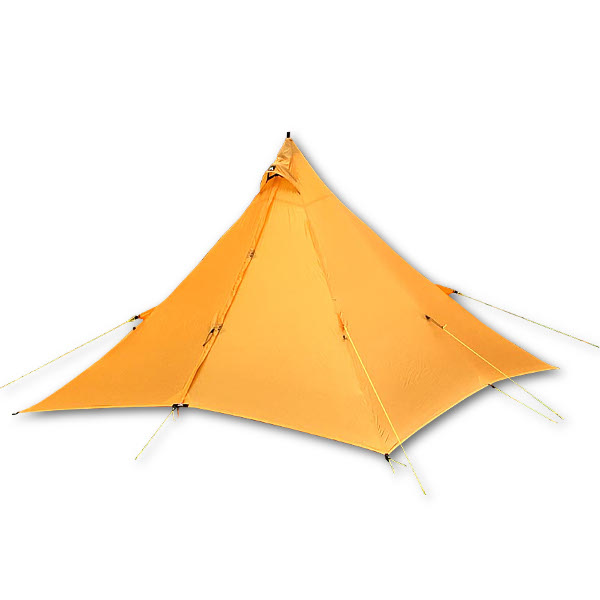
Mountain Laurel Designs - SUPERMID ™
Running these analyses costs money. Buy through my links to support the site! I may get a small commission for some links, and it doesn't cost you anything. Thank you!
Reddit Reviews:
Filter by Topic:
Based on 1 year's data from Mar 28, 2026 How it works
 -BitBang- 0.5
I've been to the mountain 4 times and summited 3 times. 1st time, Hotlum Bolam ridge: Guide supplied a BD first light to me, some other clients got REI half domes 2nd time, Hotlum Bolam ridge: Guide supplied BD first light again 3rd time, Avalanche Gulch: I brought my MLD Supermid 4th time, Clear Creek: I brought my Nemo Dagger My opinions on these tents: BD first light: Light, small, affordable, strong. But it doesn't have a vestibule, and feels really small for someone over 6 feet when your pack is inside because there's rain on the forecast. My head and feet were both touching the tent, which was covered in condensation (it's single wall...) MLD supermid: Spacious but a pain to set up. Not great as a basecamp tent because it needs your treking poles, although you can always remove them temporarily. Nemo Dagger: Very comfy and easy to set up, but not for harsh conditions. My partner attempted Avalanche Gulch (guided) earlier this year (June, but the weather was bad), the guides supplied a Mount Hardwear Trango. Indestructible but heavy. One of the guides had a Hilleberg Jannu get shredded, a Slingfin (unknown model) and the client Trangos survived. If I were looking for a four season tent right now, Id probably go Samaya if I wanted the lightest option and Slingfin if I wanted the comfortable of double-wall.
fleuron01 0.5>choosing a new 2-person UL tent I would recommend starting with those spec sheets to identify better candidates if you really do want a UL approach. The three tents you have listed here are not on the low-end of weight for a free-standing 2p shelter. >I’ve grown to prefer freestanding or semi-freestanding tents — they give us more flexibility in where we can pitch. I’m fine accepting a bit of extra weight for that convenience and versatility. I am going to do my best to politely dissuade you from your core assumption that a free-standing tent is the solution to your needs here and point you instead to a mid-style shelter. >it’s really uncomfortable: there’s barely enough space to lie down, and sitting inside with two people is basically impossible. You want to maximize the footprint while still getting decent headroom. For these reasons, (and others I hit later), I would open your scope somewhat and consider a mid-style shelter i.e. MLD's Supermid. It checks your boxes for space (and then some), is lighter than the options you have identified, and mid shelters are notoriously durable because of the way they shed weather. It is in theory a single wall shelter, but they handle moisture better due to the cross breeze you can get even with a tight pitch that hugs the ground. The Duomid cuts down significantly on interior space (still within the realm of the tents you mentioned), but it is designed for two people and their gear—pending your comfort levels in close proximity, this would be a fantastic option as well. Both options are lighter than the three tents you listed, though the Supermid with an additional silnylon inner approaches the weight of the three tents. One thing to note though: it's waaaay bigger, like, sleeps four people big, so it isn't a 1:1 comparison there. >At the moment, I’m really torn...I’m still worried about its real-world resistance to strong wind and prolonged rain Point for a mid over a free-standing shelter. Famously weather resistant, mid shelters rule highly variable conditions. >repairability and replacement Slap a silpoly patch on any holes you would develop. Repair is dead simple with a mid. Pole repair on-trail is usually impossible with a free-standing tent pole due to the nature of the shelter's needs. A mid shelter (1) would handle the adverse conditions far better, likely avoiding any need for repair outright, and (2) if you did somehow manage to mangle a pole, a replacement stick is far more readily available for a mid than it would otherwise be for a free-standing tent. >proven wind and rain resistance, but I’m less enthusiastic about the single-wall design, the extra weight, and the bulkier packed size Another point for a mid-style shelter. It really does seem to check ALL your boxes except for versatility of pitch, but I'm not quite sure I buy this either—there are tons of ways to pitch a mid shelter even on bare granite face: little rock big rock is the obvious choice here, and not hard to master. As I stated above, mid shelters avoid many of the classic enclosed single-wall fallbacks by way of the airflow you can get even with a pitch that hugs the ground. Additionally, MLD offers inners for both the Duo and Supermid, so you can solve that issue with that add-on, though it's likely unnecessary outside of really humid/wet conditions. As for weight and bulk, no issues there: a silpoly mid packs small and is likely half the weight of the three aforementioned tents in the case of the Super in its simplest iteration, and even less for a Duo. There are too many optional add-ons to give a full detailing here of weight comparisons; a quick peek at the Duo and Supermid's product page would give you all the info you need. >lower hydrostatic head makes me wonder how comfortable it really is during long periods of rain It significantly bumps the price up, go figure, but a DCF Duomid or Supermid checks that box for you. Now, DCF would make it a bulky option again, but if you prioritize water impermeability over everything else, that's your answer. Due to the sloped nature of a mid, they almost universally handle pounding rain better than a free-standing tent anyway, giving you more wiggle room in truly adverse conditions, so you could still be fine with the silpoly offering. They don't mention the hydrostatic head of either fabric on the product page, but a simple email to Ron at MLD could fix that for you. >Overall, I want a tent that lets us be quite flexible in where we camp, handles wind and rain well, and is still reasonably light and compact for backpacking and bikepacking. It really, truly sounds like a mid shelter fits all your needs. They do all the above and then some better than free-standing tents, and you have the added bonus of further flexibility in terms of on-trail repairability.
FuguSandwich 0.5>I don't know of any single-pole design that would perform better MLD Solomid/Duomid/Supermid HMG Ultamid 1/2/4 Locus Gear Khufu/Khafra Black Diamond Megalight Oware Pyramid Basically any single pole traditional mid with steep sides will do better with snow loading than the two pole and asymmetrical mids.
grumpsaboy 0.5I disagree with the people saying that your question isn't suitable for the UL sub. Ultralight isn't about being below five kilos in pack weight. It's about removing any needless weight for the job you are doing. If you're in 17 miles an hour of course you're going to need a stronger tent than if you're in five miles an hour. And if it's -30 C then your clothes are going to be heavier than if you're in 10C in order to keep you warm. On the topic of the tent question the only genuinely lightweight tent that you will find for four season will be a pyramid or tarp style tent. The MLD Trailstar is exceptional against wind but awful against snow so you need a more classical pyramid shape like the MLD Supermid. A classic pyramid shape will be very good against snow loading as they are so steep the snow can't reach thick enough to cause a collapse and they are still pretty good in wind provided you have a strong enough pole in the center and they came with enough guidelines because some like the hyperlite ultra-mid apparently underperform quite a bit in wind compared to something like the super mid (please will everyone stop calling their tents something mid). Quite a few people sleep on the pyramid 10 ignoring how strong they can be if designed for strength. Designed puts all of the force onto the pole but through compression instead of bending which is the force a pole will be strongest in and so they can survive lots of pressure put on that pole which comes from the wind and due to their fairly aerodynamic shape the wind will also not be applying that much force onto the pole to begin with. But pyramid tents do still have an upper limit, morso in wind than anything else. If you need a stronger tent then you need to ask what exactly you will be camping in to determine what type of tent. A geodesic dome like the Soulo or abisko dome will perform best under snow loading and wind particularly from any direction so if you're in places where wind speed might change often they are very good choice. Tunnel tents however are more weight efficient for the amount of strength and space they give. In the lengthway they might even be slightly stronger than 4 geodesic Dome as they are that little bit more streamline although from the side they will be worse but still pretty strong. The biggest factor of a tunnel 10 however is that the snow loading will be less than a dome tent. But there is a reason tunnel tents are the favorite for expeditions. But also what is your pack size because if you are cross-country skiing because the snow is that deep and pulling everything on a pulk to make it a lot easier to carry the weight you need then having the extra space in a tunnel tent will be very helpful. If the snow isn't all that deep and so you're able to just walk with boots or snowshoes and stick everything in a pack then a dome will probably be the best as for the same way you can get a lot stronger and so take it out in even worse conditions then you are planning. And lastly if there's just going to be high wind instead of very high wind then a pyramid tent will be more than adequate. The scarp is a strong tent, I'm not really sure how you're getting it to double the price unless hillerberg offers Swedish discounts because in most places they are half the price of a hillberg. The Xmid2 isn't really cut out for Swedish winters. It's fine under snow loading because of the steep angles and can reach surprisingly high winds for a two pole tracking pole tent particularly with all the guidelines but is ok up to 45mph (reports of higher but even Dan himself said he doubted those reports). For through hikes and what most people will be doing in ultralight that is more than strong enough but Scandinavia and the UK receive very high winds in winter and you will normally assume you will experience at least a 40mph and if the weather becomes worse than expected it won't be unrealistic to say that you might experience 60mph on any large hill or mountain at least once a week and quite often not all that predictable for when it will happen. A couple other brands you should look at are Fjallraven, Nortent and the Nordisk Seiland. All are Scandinavian manufacturers. Terranova makes some strong four season tents such as the Southern cross which might be the lightest weight four season tent you will be able to find that is a classic tent instead of a pyramid tent. But you really need to ask yourself what you will actually be doing on these hikes. If you are summit camping then you will need something like a nallo, Seiland or abisko dome because nothing else could be strong enough for the wins that you might get. If you are camping in the forest however the trees will massively reduce the wind you receive and so even an X-mid could be strong enough and a pyramid tent will definitely be strong enough.
wrunderwood 0.5Not a lot of three person tents, but there are some roomier tents. Six Moon Designs has some "outfitter" tents in your price range. Those are made of less exotic materials and are a little heavier. The company is named for the time it takes to hike the PCT (six months), so they are designed for the western mountains. Gossamer Gear is good. I've had one of their catenary cut tarps for years. Mountain Laurel Designs makes pyramid tents. I carried their Speedmid for years and recently got their Supermid. That can fit four people. It is a palace for two. It does come with a pole, because it is taller than works for trekking poles. It is the latest iteration of a pyramid design that goes back to the Chouinard Pyramid and before that to cotton tents used in Himalayan expeditions in the 1930s. Tarptent is another designer for the western mountains. Durston is very popular, nice designs.
DIY14410 0.1I've done a fair bit of touring using a 'mid shelter, first an OG MegaMid, then a MegaLight. (I've also used MLD 'mid shelters for backpacking and climbing.) A 'mid shelter is the most weight/space efficient ski touring shelter (other than a snow cave), but it has limitations in very stormy conditions It is thus a viable choice if you limit your tours to days with good (i.e., non-stormy) weather forecasts. A few tips re snow camping with a 'mid shelter: * We usually dug a square hole 2 or 3 feet (i.e., up to 1 meter) deep and erected the 'mid shelter centered over the hole. We made the hole roughly 1 foot (30cm) or so smaller on each of the 4 edges than the 'mid shelter perimeter. For example, for a BD MegaSnow with a footprint is 106" x 106", we would dig a square hold around 94" x 94". Be sure that you have a center pole long enough to do this. * To avoid having the centerpole stabbing the snow and sinking, place the bottom of the center pole on something with flat surface of some sort to disperse the load. I've used several things for this, including an avy shovel blade with the handle removed. * Bring loops of paracord and girth hitch them to the shelter's stake tie outs. IME, skis and ice axes work best for stakes. An alternative is to anchor with deadman, which come in different forms, e.g., a buried stuff bag full of snow. 'Mid shelters have more load on the tie outs than a freestanding tent, and thus snow stakes sometimes work in firm snow but sometimes easily pull out. * Many people use two ski poles strapped together to make a center pole. Although that works, we usually preferred a dedicated center pole, e.g., BD CF pole which comes with the BD MegaLight and MegaSnow. You may need to make a pole jack of some sort if you dig the square hole as described above. * You can cook inside a 'mid shelter, which is a nice feature, but be certain to have ample gaps in the side of the tent to allow fresh air to enter the tent, and open the top vent as wide as possible. * Because 'mid-shelters are single-wall, expect condensation issues. Some days will be worse than others. On cold nights, the condensation may freeze on the shelter walls. On warmer nights, when the condensation is in liquid state, bring a ChamWow (or Amazon knockoff) to wipe the condensation. * Prepare your backpack such that you can strap a wet 'mid shelter on the outside of the pack.
End of reviews