
Running these analyses costs money. Buy through my links to help keep lights on! I may get a small commission.
Reddit Reviews
 KCatty
[Hamilton Beach 12 cup programmable coffee maker](https://www.kohls.com/product/prd-6857113/hamilton-beach-12-cup-programmable-coffee-maker.jsp?color=Black&prdPV=4) I had this for years and it worked great. Bought one for my dad who is the opposite of tech savvy and it has worked great for him for going on 10 years.
barium711Hamilton Beach is the unsung hero IMHO. Been using mine for 12 years with no issues.
eveningcaffeineMy trusty Hamilton Beach has lasted 9 years so far
gazingusThis. Hamilton Beach, Proctor-Silex, Krups, KitchenAid, Bella, Black and Decker(!) - any basic drip machine will do the trick. $20-50. Filters are cheap, cleaning/descaling is easy, They will last 5-10 years before you need to buy a replacement. Feature wise, you need to decide if you want auto-shutoff, or you want a "dumb" machine that just has an on/off switch, so it can keep warm for more than two hours, as long you're not forgetful.
LLR1960There's some overheating/fire issues with some Cuisinarts. My favorite has been Hamilton Beach. They seem to last and don't cost an arm and a leg.
Sad-Pen4855I've tried 3 different coffee machines in 3 years and they all died within 18 months. Looking for the best coffee machine for 2026 that'll actually last 5+ years. Need something reliable for daily use (2-3 cups), easy to clean, under $300. What are the best coffee machines you've owned long-term? Considering Technivorm, Breville, or Ninja. Which coffee machine would you buy? Help!
Okay so I've killed 3 coffee machines in 3 years - Mr. Coffee lasted 14 months, Hamilton Beach died at 13 months, and my current cheap Amazon one is dying at 10 months. Clearly doing something wrong lol. Looking at Technivorm Moccamaster ($300), Breville Precision ($250), or mid-range like Ninja/OXO ($150-200). Is spending more actually worth it or will I just break those too? What's the best coffee machine under $300 that actually survives daily use? Do expensive coffee machines genuinely last longer? I use tap water and descale every few months - is that my problem? Honestly just need something reliable that won't die in a year. What are the best coffee machines you've used long-term without issues?
Top-Rope6148It really has nothing to do with wattage. All machines that work on what most people call a “thermosiphon” principle (although that’s really not what it is) have to get the water to boiling in order to get it into the coffee. It’s the steam that propels the coffee up and over and into the grinds. So in every machine the water starts out at boiling. So wattage really has nothing to do with it. It’s only heating a small tube of water. The steam that pushes it through lives in that tube. The problem with cheaper machines is the cheap silicone tube that feeds the hot water to the coffee grinds goes through the reservoir of fresh water on its way up. That water acts as a heat sink that cools the water. So the first bit of water is going through a nearly full reservoir. As the reservoir goes down the heat sink gets smaller. So the first water starts out without enough heat and gradually gets hotter as the brew progresses. You can minimize this problem by pre-heating your water but not so much that it melts anything in the part of the machine not intended for hot water. Also don’t use water from your household water heater. Honestly not really worth it. Better coffee makers solve this problem in different ways. Many machines solve it by putting an outer tube around the feed tube creating an air gap of insulation. The Moccamaster and Oxo do this. Other machines like Bunn dump the thermosiphon approach and heat the water in a holding tank above the coffee and open a valve when the whole tank reaches temperature. These are really more ideal from a temperature perspective as long as they get the temperature right before the valve opens. The downside is they take longer because you have to wait until the whole batch of water is hot before you can start brewing. Thermosiphon machines brew the coffee incrementally, heating while they brew. This is why alot of Bunn coffeemakers have a tank that holds hot water 24/7. When you brew you displace the already hot water with fresh water. The way boiler size and wattage come into play in either type of machine is in how fast you get your coffee. Does all this matter? I think not as much as people think it does. Getting the grind size right to match your taste for the machine you are using matters much more. I’ve had pretty good coffee from a $40 Hamilton Beach with a good bean and the right grind.
I don’t think this cold leg is being addressed unless possibly the few models that add the complication of a pump. Honestly gravity feed, heating all the water to temp and then opening a valve is the most effective and elegant design. I suspect the extended brew time is what keeps it from dominating the market. I observed the level come up this morning in my moccamaster (it uses a clear glass tube surrounded by a clear plastic insulating sleeve). I run a few ounces through before I brew to clear the boiler and tubing of the water left in from the last brew and preheat everything. This helps mitigate this cold leg because hot water is left in the tubing and most of the cold water displacing it is filling the boiler, which in the moccamaster is a relatively large piece of copper tubing that holds 3 oz. So if you preheat, the moccamaster would not be very effected by this cold leg. Very interesting. Thanks for your input. The drip coffeemaker is kind of fascinating for its simplicity and effectiveness.
Finer grind slows the flow of water through the coffee grounds. Coarse grind lets it flow through faster. Slower flow makes stronger brew but at some point you over extract the coffee and it gets bitter. Faster flow gives you a “weaker” brew and if too weak can taste sour. Because there are hydraulic differences coming from the design of the brew funnel or basket, as well as the rate at which the water is dispensed into it, you have to experiment to find the grind that gives your preferred flavor for any machine you use. They’re all a bit different.
End of reviews
Rankings by Use Case
Top recommendations from others in the same boat
Best for Enthusiast brew control

Top pick
Fellow - Aiden Precision Coffee Maker
Best for Families and hosting
Top pick
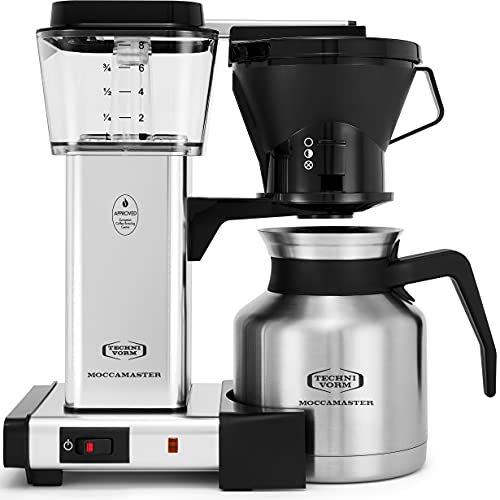
Moccamaster (Technivorm) - KB Series
Best for Long-term heat retention
Top pick
Moccamaster (Technivorm) - KB Series
Best for Long-term reliability (BIFL)
Top pick
Moccamaster (Technivorm) - KB Series
Best for Morning scheduling

Top pick
Breville - Precision Brewer Thermal Carafe
Best for Plastic-free brewing

Top pick
Simply Good Coffee - Brewer