
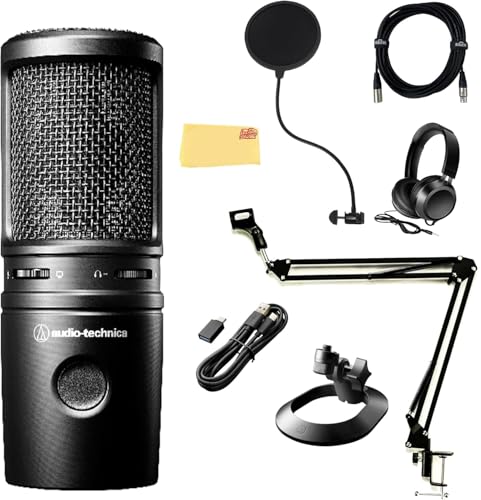
AT2020USB-X
Running these analyses costs money. Buy through my links to help keep lights on! I may get a small commission.
Reddit Reviews
 anothersip 1.0
There are tons of options out there for ya'. Sifting through them all can be a bit of a pain. There are USB mics and XLR mics - some mics have both options. But in your shoes, I'd go with a mic with XLR-out and a seperate USB audio interface with XLR-in. It'll be a bit more modular that way in case you ever wanna' upgrade either your mic or interface. Some of the highly-rated mics I've seen mentioned that are affordable would be something like the [Audio-Techica AT2020USB-X](https://www.audio-technica.com/en-us/at2020usb-x) for ~$170. I've got a few pieces of AT gear and it has held up really well over the years. I like the sound quality. There's also the ever-popular Blue Yeti, which can be had [for around ~$100](https://www.bestbuy.com/product/blue-microphones-blue-yeti-professional-multi-pattern-usb-condenser-microphone-midnight-blue/J7H7ZY82LY/sku/5963805?utm_source=feed&extStoreId=1385). It's natively a USB mic, which would make it really easy to plug-n-play. I've heard good things about it. You've got a few options in terms of connectivity, but if you'd prefer a bit more maneuverability, you could go with a mic that has a standard mic XLR output and hook it into an audio interface instead. That's what I would do, personally. It would allow you to upgrade mics further down the line, if you ever wanted to. (The USB mics have an interface built-in, which is why they connect directly via USB most of the time and don't require a seperate interface. But yeah, since some mics are XLR as well as USB, it allows you to use their internal sound chips instead of your interface's, if you wanted - ([here are some pros/cons of each](https://www.buzzsprout.com/blog/usb-mic-vs-xlr)). Personally, I've got a [Marantz MPM-1000](https://www.marantzpro.com/products/mpm-1000) (non-usb) which I've been diggin'. It was really affordable, I think I paid <$100 for mine. And I'm really happy with it - I've recorded many VO's with it for my video production stuff. But there are definitely hundreds and hundreds of affordable, professional-sounding mics out there. I personally just use a [USB-C-to-USB dongle/adapter](https://a.co/d/8iTl0c6) to hook my interface to my MacBook since it's got USB-C ports only for peripherals. Interface plugs into the dongle, mic plugs into the XLR input on the interface, turn it all on, boot up the DAW or your streaming service on your phone and change your audio input settings to the mic/interface, do your sound-check, and you'll be good-to-go. I'd use some headphones during your testing, as well as some decent speakers so you know what you'll be sounding like to other people. Or you can turn monitoring on or whatever and test. Hope that helps a bit!
ItinerantFella 1.0Always use two mics. Two ATR2020x or Samson Q2U are budget friendly. They have XLR and USB connections. You'll need an audio mixer if you want to use XLR or two computers if you want to use USB.
Prizem 1.0lol yes! For easy starters, Elgato Wave Neo ($85), Elgato Wave 3 ($150), Blue Yeti ($100), and AT2020USB-X ($140) are simple plug and play USB mics which are all around good intros for audio. Could still be good to get a stand and pop filter if they don't include them.
scoutermike 1.0I have both the 2020 and the N1. Both good mics, N1 slightly better. You should be happy with either. Both better than a Snowball.
spicyface 1.0The NT1 is the best mic of that group but you will need an interface between the mic and computer that has an XLR input(s) (like what comes with the Behringer mic). The Audio Technica is the only mic in the list that doesn't need / come with a audio interface.
BeigeListed 0.5The mic is absolutely a solid starting point. It’s a step up from the lowest-end USB mics and it’s easy to plug in and make something that doesn’t sound like you’re in a tunnel. Here’s the truth about it: Can you do amateur work with it? Yes. Amateur podcasts, YouTube stuff, hobby voiceover, stream chats - it’ll get you there. You can be intelligible, clean, and listenable. Can it take you to professional voiceover? Maybe, but not automatically. Voiceover isn’t about the mic alone. It’s about **performance, mic technique, room control, editing, and delivery**. Pros use better gear because those tools help capture more detail and give engineers flexibility. But plenty of working pros started on modest mics and upgraded only when their business needed it. If you only have the AT2020USBX today, work with it. Learn about **placement, room treatment, and editing**. That’s where most people actually improve the sound more than changing gear. When you find yourself booking paying gigs regularly, then consider stepping up to an XLR setup with an interface and maybe a mic that suits your voice better. That’s when the investment actually pays you back. A few practical points: * USB is convenient, but XLR rigs give you **more control and better quality ceiling**. * Treat your room as part of the chain. Even a cheap reflection filter or blankets on walls makes a bigger difference than swapping mics. * Your voice and performance matter far more than the exact model of mic. Mic alone won’t make you a pro. Discipline, craft, and consistency will.
Kithzerai-Istik 0.5It’s my daily driver. I’ve recorded a lot of audiobooks through ACX and done a few video game parts using it without any issue. As others have said, it’s the room treatment (I’ve got an insulated closet converted into a booth), your acting, and your editing that’ll carry the rest.
Waterflowstech 0.5I upgraded from a cheap USB mic to a calibration mic (also not ideal) to an AT2020 USBX. It makes a huge difference! Cheap USB mics have a really high noise floor, which is heavily amplified by compression. The calibration mic was a tiny bit better than the cheap USB mic but still no contest compared to the AT2020. And you can get even better mics than the AT2020 but I wanted to save money and not get an audio interface just yet and now I'm doing fine without one.
curiousiTea_ 0.3I had a lot of problems with my USB AT2020 + found the XLR version to have a tinny, hollow sound. Get a dynamic mic for the same price and learn to mix!
DAWZone 0.3Good call with the SM58, it’s a solid beginner mic for vocals and it’ll still be useful as you level up. For home recording, you’ll need an audio interface to connect the mic to your computer and headphones. Something like the MOTU M2, Scarlett Solo, or even the cheaper Behringer UMC series will do the job. If at any point you decide to switch to USB, Audio-Technica AT2020 USB or Shure MV7 are both excellent and more plug-and-play. But with the SM58, you're starting with something versatile that’ll last.