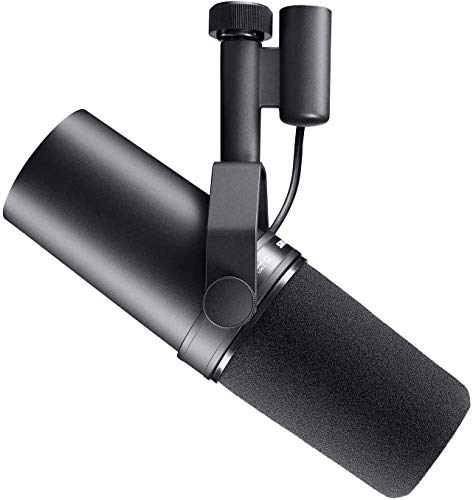
I agree with the people saying Shure SM- 57 or 58 is enough to get the job done.
They will work for pretty much whatever you need but you should also explore a higher end mic for vocals.
I like condensers but it really depends on your voice and the style of music you’re making.
If you get a chance to try out other mics, do it.
I used a friend’s Shure Beta 87-A and it sounded really great.
There are some decent budget friendly mics to look into.
I like the CAD A77 so much I bought a spare. And when the black version came out I got one of those just because it was more affordable than the gold one.
The Blue Raven and Blue Cardinal are not being made anymore but they are great mics.
For live vocals I alternate between the Raven and the A77.
I also have a Blue Spark and a Bluebird. Something about the Bluebird doesn’t sit well with me.
Probably just the timbre of my voice, or maybe I just need to experiment more with it.
I got a Heil Fin microphone for a friend and it works well with her voice. It also has LED lights that use phantom power and gives her face a beautiful soft glow, which is great for live shows.
Everyone complaining about cupping the mic - yeah that shit's hard to deal with but whatever. Some days you have easy shows and some days you work for that money.
Pull up a hypercardioid condenser mic - beta87A, e865, OM7, V7, etc pick your poison - to cut back on some of the proximity effect and know that you're gonna be getting more honk and less clarity so test the mic that way during soundcheck.
Doubly important if your artist isn't showing up for soundcheck - a lot of times it's their "guy" showing up because "aura" or some shit like that. Maybe they're busy setting off the venue fire alarm by smoking in the green room under the "no smoking" sign and the chemical sensors so they send someone with limited live sound knowledge and working vocabulary - a DJ, a fader jockey, their studio guy, something like that. Not that I'm speaking from experience there or anything. Definitely didn't have to evacuate an entire casino for no fucking reason once, no sir.
Have someone from your team cup that mic with both hands around the grill and scream into it like it owes them money. Ring it out in the wedges and the mains - there's only so much you can do because we're limited by physics at the very bleeding edge of processing and performance. If you're lucky enough to have plugin processing, this is where that can really shine - C6 type compressors were designed for this exact use case. The more work you do on it ahead of time the less work you have to do during the show.
Not those. They have no transformer, not sure how they’re wired. Get the xm8500, the e609 knockoff and beta91 are excellent. The beta87 is meh and I use them in place of a small diaphragm condenser since it has its own wind screen
My favorite mic for rejecting background echo is the Shure Beta 87a. But it does need phantom power. My inspiration was Fizzle’s nice write up on different mic options with audio sound tests here: https://fizzle.co/podcast-high-quality-microphone-shootout/.
You can pick up a Shure Beta 87A (handheld condenser) for around $300, plus you can use it on stage, and it will sound great. Get one for everyone in the band who sings.
A Røde NT2-A (switchable patterns) should run about $420, plus $70 for the shockmount and pop filter.
Either of these will add a substantial amount of clarity and detail to the vocals if you've been using a $100 dynamic mic, like an SM58. In real life, it means that your vocals won't sound as if they're under a blanket in your mix. (Not being snarky.) And live—with those Beta 87As, your stage vocals will have much more definition.
While these aren't U87-level solutions, they're enough to hear a substantial difference. This is like comparing a decent hamburger to a great prime rib, with the U87 perhaps being the Wagyu beef platter overseen by Chef Morimoto.
It sounds like you only have 1 mic/1 input available at any given time. The part I don't like about that is that you might be missing out on the possibility of a stereo image on the piano. If you were to ask me(and probably ONLY me), I'd say 2 of those Beta 58s or even the Beta 87s would be just fine on a piano, BUT YES... it WOULD pick up a lot of the clack and clunk from the keys.... however, some people like that. Even if you only had 1 mic for the piano, those Betas sound pretty good. If you are looking for an upgrade on mics that will give you a studio sound with less "condenser" sensitivity, I would recommend Ribbon Mics like the sE Electronics X1R. These mics are not too expensive at all, and they sound like a dream (especially for how inexpensive they are). However, they are definitely not as "bright" as a condenser mic.
The other thing I'd say is that even a standard SM58 sounds decent for vocals in a studio setting, however if it is true that you only have the one input, then regardless of mic choice; I'd recommend recording the piano first AND THEN the vocals. I certainly would not recommend using a single mic to record both the vocals AND the piano at the same time. As for the other mics you mentioned... The SM7b is AWESOME on female vocals, but it IS pretty pricey even for how good it sounds(at least in my opinion) and the Rode NT1 is simply a horrible choice all together. I'd rather one of the Betas on a piano before the NT1. You'd definitely be better off with a Ribbon mic (or 2, since you should be going for stereo image anyway) OR even an NT5 before that NT1. In any case.... Those fluid performances CAN still be recorded independently from each other, especially if you are like me because I cannot fathom doing an entire performance without a click for at least the main portion of it.
Top External Microphones on Reddit
1
Shure
SM58
79% positive of 381 users
Indestructible live workhorse; but muffled for studio vocals.



 BusyBullet