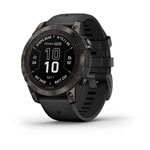
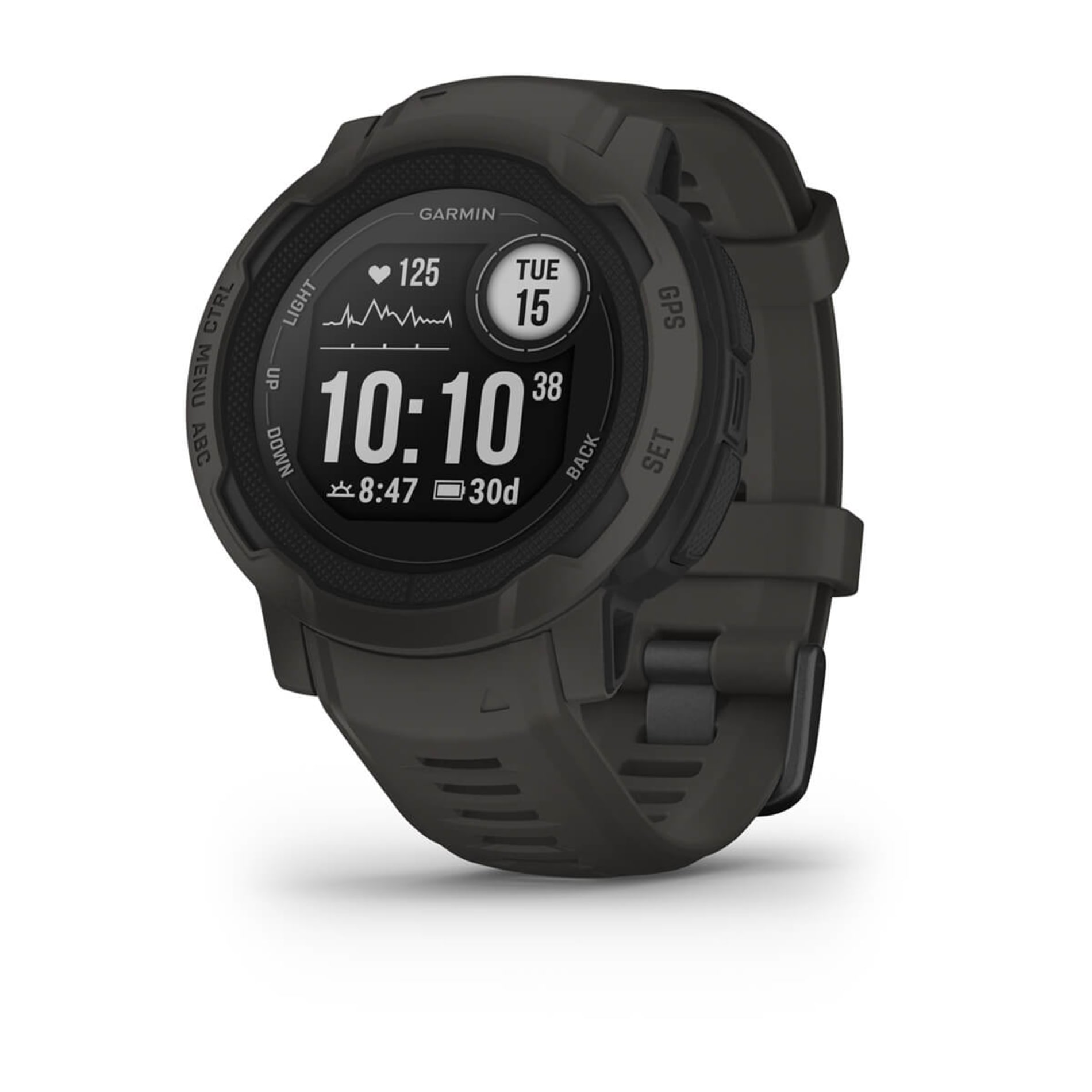
Check whether this reality. My crossover says I have 51 days battery life when the hr sensor is switched off, but in real life, it's about 33 days. Still amazing, but less.
Watch Concept: I use the Instinct Crossover, best hybrid watch on the market. Use: telling time, alarm, notifications and breadcrumb navigation while hiking. Nothing else.
I appreciate the craftsmanship in mechanical watches, but it's really just jewellery to me. I prefer functionality more. So I mostly use the Garmin Instinct Crossover, which has physical watch hands which I love and only have important notifications on.
take a look at the garmin instinct crossover - its basically an instinct with the full tracking capabilities of the instinct, but with mechanical hands - the solar versions give you a pretty long time between charges too.
Garmin offers most of these:
accurate hr depends on you - but yes the current sensors are good and work well for most people, but also may depend on the activities you want to track.
all garmins are at least 5atm - which is good for swimming and other low pressure/speed water sports. They do also offer 10atm (high speed/pressure water sports) and full dive watches (closest you will get to water proof as include inductive buttons).
sleep yes - make sure spec says sleep score and ideally sleep coach - though is like this for all current models - not only see quality but can get detailed breakdown of the sleep score components.
Body Battery (BB) - yes all do but this is an assessment of your energy levels not necessarily your health. The new health status metric which monitors your HR, HRV, respiration, skin temp and pulse ox (spo2)) across time is a more accurate measure of health status.
Recovery - garmin does this in a couple of way - most current garmin's provide an estimate recovery time - which is an estimate of how long until your body has recovered so that can gain max benefit from next hard workout - will adjust based on any activity done, your stress levels and sleep quality. can see this value on the watch at any time, including the ability to add as a watch face data point.
Post activity you can do a recovery mode - before saving your activity press the recovery HR option - will now track your HR for two minutes while you rest - then press save when done. If you go into your activity and go to the stats section under HR it will show the recovery HR value i.e. 10bpm (what you HR went down during those 2 minutes). Of course for the activity you can see the HR chart fo the the tracked activity. If you wanted to track your HR for the 2 minute recovery period you can save the activity and then launch a health snapshot - this tracks your HR, pulse ox (spo2), respiration and stress for a 2 mins and provides average hrv metrics for that period - putting this into a pdf file you can download, see on phone/web etc.
Workout HR zone - yes get visible and audable notification - can also get an audio note. Can have it set as an alert or can set it as a workout screen in which case adds a screen showing zone in green with other zones in red - so very easy to see when in or out of zone. (note can do this with other metrics too like pace, cadence etc).
yes can set max/min alerts too. But think its pretty similar in terms of alerts.
Pace indicator - yes - can set from 1 to 8 data fields per tracking screen (how many may depend on model and screen size but most now do 1-6 fields - though guage fields can reduce it by 1-2 fields depending on whether using 1 or 2 guages and screen size), and can do from 3 to unlimited (as such) tracking screens (depends on model). Can set up pace workout screen, or pace guage on tracking screen or just pace data fields (i..e. current pace, last lap pace, avg lap pace etc etc etc). See the data fields section of watch manual to see data field options.
Watch face horizontal - stock garmins offer ones where hour is above minutes - but if you don't like the options there is always the garmin connect iq store (app on watch for some models, app on phone or web browser: [https://apps.garmin.com/](https://apps.garmin.com/) so you can have a look to get idea of options - there are also some other 3rd party sites where you can also get other 3rd party watch faces from).
All garmins offer abnormal HR alerts and offer the ability to set HR alerts for an activity (can set these for each individual activity type and for models that offer activity copy action can set up multiple copies of same activity with different HR alerts making it quick and easy to select which one you want without having to go in and change the alert values)..
all current garmins have very accurate gps.
Sub £600 -- covers most garmins on offer. Depending on what types of activity you do and what sort of features you want, and whether want mic & speaker. But would suggest looking at the vivoactive, forerunner, instinct and fenix ranges as that probably is more in line with what you want.
Basically gamrin health features (except ecg and baseline temp) and smart features (except offline music) are the same - its really the fitness features and training metrics where they really differentiate and even then its getting way closer (i.e ..not much difference between a venu 4 and forerunner 570).
you would need to check re saving points of interest, but in regards to offline maps, ability to save routes and then have them overlaid on the offine maps etc pretty much most brands now offer this functionality - would stick with amazfit, huawei, garmin, coros, polar and suunto models for best features around this.
I know that with garmin instinct and fenix (and its variants) and the FR variants with offline maps you can save points at any time. In fact the fenix/FR with offline maps can even create a route on the watch from a saved point on the watch - very useful if you save hunting points and want to get from one point to the next and don't have a pre-planned route, or even decide you want to break off a route short and want to get back to the start - no need to retrace your route, or have to follow a bearing line to it - the wach can create a route back to the start.
For the garmin's that don't have offline maps, note there are 3rd party apps like komoot that can provide the similar functionality as suunto, coros, polar, amazfit and huawei i.e. create an offline route on app/web and sync to watch with offline map section.
Note that the fenix/instinct garmins come with built in hunt functionality - [https://www8.garmin.com/manuals/webhelp/GUID-EECCAC99-90D6-4AB1-9A3A-EC433D3365E2/EN-US/GUID-135067A5-7E0B-4467-A79C-D084B20D1DE1.html](https://www8.garmin.com/manuals/webhelp/GUID-EECCAC99-90D6-4AB1-9A3A-EC433D3365E2/EN-US/GUID-135067A5-7E0B-4467-A79C-D084B20D1DE1.html)
as you main focus is swimming I would stick with a garmin (the 5 buttons ones so a forerunner, instinct, fenix (and its variants like epix); suunto, polar or coros.
Having the buttons enables you to swap data tracking screens while resting to check stats.
as to which is best will depend on the swimming stats and features you require.
rock climbing - would suggest sticking to garmin or coros as those are the only 2 that provide that functionality. Note its limited to only a couple of models on coros, whereas on garmin its on most models.
Haven't had a coros so can't comment much on it. Re Garmin - you would have to manually adjust your sleep schedule but its pretty easy to do via the app - so a bit of a PITA but not a deal breaker.
You want something fairly durable if wearing while on duty - so would suggest either the coros vertix series (maybe nomad - don't know much about it) or the garmin fenix / instince series. Advantage of coros and fenix is the built in offline mapping for hiking.. Would give the edge to garmin in terms of the hiking and fishing as their built in aps for this are just better. (note that if using the instinct 3 amoled you can install a 3rd party offline map option, however no offline music option). Garmin Fenix does include offline spotify (assuming you have a sub), whereas as Coros offers your own mp3s only.
the best watch is the one that best meets your needs and is a price you can afford. Also note that apple watches are locked to iPhone and cannot work with android; and similarly wear os (pixel, samsung, oneplus, ticwatch etc) are locked to android and cannot work with iPhone.
Should also look at garmin, coros, polar, suunto, amazfit, huawei and fitbit - will all work with either android or iPhone.
Best option might be to talk about what you want out of a smartwatch from a) smarts, b) health, c) tracking fitness - talk about what types of activity and level of data; d) any of useful info - i.e. battery life, torch, offline maps, scuba diving, tracking golf, shootiing, hunting, track flight hours, climbing (indoor or outdoor), high speed/pressure sports like surfing, kite boarding etc etc. These days you name it and their is likely an option that will cover what you want - its just the cost where you may have to compromise.
I think you need to understand HRV - to take a HRV recording you have to be inactive as being active impacts your HRV, hence while it will only show stress during the day for inactive periods - if being exercising it will only show it a certain period post activity as that impacts HRV too, so has to wait for your ANS to recover from the activity before it can start to show it again. If any watch is showing you HRV during active periods its giving you garbage as they don't understand how your ANS is impacted by activity. All day stress is really only useful in terms of looking at your daily average as a trend - there are too many factors that can otherwise impact it. If you want more info about the stress metric and HRV would suggest starting with Firstbeats white paper on the stress metric (considering they are the first ones to introduce that metric).
Re the HR - were you actively tracking an exercise session or just looking at the HR widget - if just looking at the widget track an activity as in 24/7 mode its running at reduced power for HR, when tracking an activity it pushes up to full power mode.
actually technically the apple watch doesn't measure HRV continuously - it only measures it every 2 to 5 hours and it will take the readings more frequently when you are sedentary or in specific conditions like when you are sleeping, or when AFIB mode is active (this can increase the HRV tracking feature to every hour or so). But the during the day readings are of very limited value - its the variation to the trend over time that is way more important.
The really important HRV readings are those that are done during your sleep period as there are less factors that can influence the readings.
This is a line worth reading - it is potentially biased as his showing why his software is better - but the underlying concepts are valid. And while it has been updated , as its a couple of years old now and hence why the original data didn't include apple watch cause at that time their HRV was absolutely useless, and since then all of the brands have also improved their HRV reporting etc (garmin's for example is now continuous during the night) - it doesn't change the underlying message / principle. Taking readings during the day is of very very limited use.
As you say you understand how HRV and ANS work then you should understand why there are gaps in Garmin's Stress readings and shouldn't be surprised by them, but as you stated you were surprised, it made me assume that haven't fully researched the subject / grasped how HRV and ANS work.
PS - can't remember if I stated already that for garmin you can get a direct HRV reading at any point by running the 2 min health snapshot - this will show your the HRV value on the watch - but can't display on the watch face (at least not with standard watch faces). Can pull up at any time via the health snapshot app or the health snapshot widget. But coolest thing is the ability to see a list of them in connect web - the individual reports are all pdf, but the web shows a list of them and you can also see a list of main attributes (customizable) so can your RMSSD for each recording so pretty easy to spot a trend from this if performing them regularly at a specific time. \[Within the PDF file it also includes a SDRR value\].
I am fully aware you can pull HRV during a workout (mine is set to) and know the reason - but that is very different to pulling during 24/7 where far more factors are at play than there would be during a workout. Also its a bit painful to use that activity HRV data as while its logged in the fit file the garmin connect app/web doesn't currently show that data, which of course means you have to use a 3rd party app - and currently I can't be bothered to mess around with multiple apps.
And yes most garmins running the elevate 4 or 5 HR Sensor still offer the HRV during workout (for main activities).
Note that if the watch offers the performance condition data metric, which can set on data screen and get alerts for it - and while its not a purely HRV related - it does include HRV along with pace and HR to provide a real time assessment of your deviation to your baseline VO2max. And while I know this is more than just HRV I feel that to a degree its sort of incorporating what HRV logging does i.e .how your body is adapting to the training load of that session.
Worth noting that all of the 4 fitness brands - garmin, coros, polar and suunto all only do HRV as overnight not during day (Suunto does offer resources which is sort of like garmin's body battery and also sort of does take stress (based off hrv) into account) - for the same reason - too many drivers could be impacting it; Coros does offer a manual record too like Garmin does.
Also when you think about it the purpose of Apples all day HRV is around recovery - the other brands provide a host of other metrics that do a similar think i.e. Garmin's recovery metric; training status, and training readiness --- basically providing that data is an easier to use , simplified format (and all include HRV as part of the data that is used to determine their values).
HRV logging - its on in case I ever need it /want it - if you don't log it you can't go back and get it. Yes needs chest strap as optical HR generally isn't accurate enough to get an accurate R-R interval detection.
Apps - garmin connect app store only shows the apps that are available for you watch. What I loved about the connect iq web version is you could see all the apps and then send a message to a dev to extend to your model as generally they didn't always update for new models. However since they have stupidly closed the web version of the store its now much harder to find those apps (use web search now). Alpha HRV wouldn't help you anyway as it also requires a chest strap in particular the polar h9 / H10 or garmin hrm pro. They tend to only recommend these straps as these have been validated by platforms that do HRV during an activity and thus are known to provide accurate r-r intervals.
Performance Condition: [https://www8.garmin.com/manuals/webhelp/GUID-2CF5620C-E585-4E0A-9CC3-9565533EEE4D/EN-US/GUID-7556D1C8-1685-43B9-A091-D43D2F719F1F.html](https://www8.garmin.com/manuals/webhelp/GUID-2CF5620C-E585-4E0A-9CC3-9565533EEE4D/EN-US/GUID-7556D1C8-1685-43B9-A091-D43D2F719F1F.html) V4 does have it has a metric, so you could pull it in as a data field on your tracking screens on the watch. But that is about as good as its going to get unless you go chest strap.
Always find its a compromise finding right watch - and as already stated don't really know of any watch that does what you want - as stated tech's not really there yet to set it up the way you want.
Samsung features require latest samsung phone (though its normally possible to sideload onto other android phones but can be slightly challenging) - also they have heavy region locks so would also need to know that its not locked in your country/regioni cause if it is then there is no joy - can't do what you can with garmin where ccan spoof to unlock feature and once unlocked will work anywhere (i.e. ECG).

 aadoqee