To me DT 770 Pro X are almost uncannily comfy. Same with DT 900 Pro X. I feel that they're there, but they don't interfere at all. Same with FT1 Pro with thicker/firmer leather pads: slightly increased clamp, decreased headband pressure. They're there, they're weighty, but they don't bother me.
I have several that I absolutely love and listen to every day, and I have a particular fondness for my FT1 Pro and DT770.
But my Etymotic ER2XR has my favourite tuning of any headphone or IEM I have ever tried. In a world of bloated bass and piercing treble, they absolutely nailed the tuning on the ER2XR and they sound leagues better than even the more expensive stuff I have tried. The deep fit means they have noise isolation better than a lot of dedicated earplugs and they bypass basically your entire ear so they can deliver sound straight to your eardrum which means more people get to experience the intended tuning.
I also find them more comfortable despite their deep fit. The nozzles and shells are very slim, especially compared to the modern IEM trend of having massive shells with 400 drivers per side (and usually sound like shit, but I digress).
FT1 Pro when I'm doing work here at my desk and have the silence around me to enjoy them. ER2XR if there is ongoing noise and I need the silence.
AirPods Pro 2 if I'm doing something physical or am out of the house.
Had quite a few over the years that have been and gone for various reasons. I'm rather happy with what I have now excluding maybe my FH3 which is kind of meh. My favourites at the moment are my FT1 Pro and my ER2XR, the latter of which constantly blows me away due to their size and value.
Okay, I'll start with your questions about open vs closed backs. Since you asked about bass, let me change your way of thinking about this a bit: it is easier to get higher levels of bass with a closed-back headphone. That's physics. That doesn't mean that you can't also have tons of bass from an open-back headphone. It's just that it takes more design effort. I'll point out that the majority of top-end headphones (we're talking headphones that cost thousands or even in a few rare cases, tens of thousands of dollars each) are open-back.
The big lesson here is that while of course there are generalizations of open vs closed back (more on this soon), you really need to compare individual models and not throw all headphones of a specific type under the same umbrella.
So, here are those generalizations (and again, remember that not all headphones of a specific type will lean heavily into this, or at all; you could even do something extreme like compare an affordable open-back to a top-end closed-back):
Open-back:
Pros:
* Easier to design with better levels of accuracy due to not having a lot of internal reflections and resonances to deal with.
* Generally will have a wider soundstage. Open-backs tend to be closer to a speaker-like presentation than closed-backs.
* More comfortable due to allowing your ears to breath (of course isolating this from all of the other many variables of headphone ergonomics).
Cons:
* Very little or no isolation from background noise (this can sometimes be a plus though if you want to be able to hear something like someone calling you; think of something like automatic transparency mode with ANC headphones).
* People near you will be able to hear what you're listening to, especially if you listen at higher volumes.
* More difficult to achieve higher levels of bass.
Closed-back:
Pros:
* Much better isolation from background noise.
* You can usually listen at ear destroying levels without bothering people around you.
* Easier to achieve higher levels of bass.
Cons:
* Internal resonances reduce accuracy of the headphone.
* Soundstage usually sounds more narrow (again, this is a good one to point out really depends on the individual models).
* Less comfortable due to ears being more likely to sweat (again, putting aside all other aspects of headphone ergonomics).
Personally, I'm primarily a speaker user, so when I do use headphones, I prefer open-back as they present more like speakers.
So with that out of the way, moving onto your next point: the loudness. Hi-fi headphones are usually passive (unpowered), so their max volume will be determined by the electronics you plug them into, not the headphones themselves (not counting how much power you can put into them before risking damage of course). Sure, different headphones will have different sensivities and impedances which will affect this, but ultimately, you should determine your headphone amplifier based off your headphones, not the other way around due to the fact that the headphones are the more important component.
As far as the lack of convenience of wired headphones, you can always change the length of cable. I run my main headphones on a 10' cable, which allows me to reach any part of my home office without taking my headphones off. For meetings, I do tend to just use a wireless gaming headset due to convenience (plus I work as a test engineer for a gaming peripherals brand, so I might as well use the stuff I get for free for something lol).
So, the FT1/FT1 Pro as others have mentioned are fantastic choices. Another very good open-back headphone you could consider is the Sennheiser HD 550, or if you want closed-back, the HD 620S.
By the way, since you're coming from a gaming headset, do note that you'll need to get a separate microphone if you rely on your headset's microphone. Sennheiser actually offers the [HD 500 BAM](https://newsroom.sennheiser.com/headset-mode-unlocked), which works with all of their HD 500 series headphones as well as the closed-back HD 620S.
As far as electronics go, you've got a number of options. If you want to switch between your phone and computer, there are a couple of options. There are some DAC/amps with Bluetooth inputs (so you'd connect your PC via USB and your phone via Bluetooth). You could also get a dongle DAC for your phone and a DAC that also has a line in and leave that plugged into the amp always available for your phone. Some ideas would include:
* [Schiit Fulla 2](https://www.schiit.com/products/fulla-2) - Has a high quality 3.5 mm mic in if you need it, such as with the HD 500 BAM as well as a line in for connecting your phone.
* Schiit Magni Unity (be sure to add in the optional Mesh DAC) - Allows you to easily switch between the USB input and analog line in, which again, just connect to a dongle for your phone.
* FiiO [K11](https://www.fiio.com/k11) or [K11 R2R](https://www.fiio.com/k11r2r) (R2R model will have a little bit warmer sound while the standard cheaper model is more neutral)
* FiiO [K13 R2R](https://www.fiio.com/k13r2r) - Exceeds your budget, but it's a great desktop headphone amp with a Bluetooth input that you could maybe save up for)
* JDS Labs [Atom DAC 2](https://jdslabs.com/product/atom-dac-2/) + [Atom Amp 2](https://jdslabs.com/product/atom-amp-2/) - Great combo where the amp has 2 inputs. You'd connect 1 to your PC (likely through a DAC) and 1 to your phone. If your budget is too tight, you can start with the amp and add the DAC later on.
You're welcome!
Regarding amps and DACs, the amp will make a significantly bigger difference in most cases. The one exception to that is if you're plugging into a PC or other digital audio source that has really noisy integrated audio. Using an external DAC allows you to completely bypass the integrated audio and usually the noise. Beyond that, the differences between DACs are typically subtle.
You're right that the primary purpose of an amp is to provide enough power to listen at the level you'd like. It's a little bit more complicated than that though (and to be totally honest, I'm also not an expert in amplifier design, so I can only explain this in so much detail). For example, lower frequencies require (a lot) more power than high frequencies, so you could have a situation where you can an overall level high enough, but perhaps your bass isn't where you'd like it to bee (distorted, slow/uncontrolled, etc.). Ultimately, there are more variables than just power, such as distortion, output impedance, slew rate, noise floor, and topology.
I can give you an example from my own gear collection: I own 2 (open-back) planar magnetic headphones (like the FT1 Pro). An Audeze LCD-X and a Dan Clark Audio Ether Flow 1.1. With my 1 tube amp, my Woo Audio WA7 Fireflies (2nd Generation), my LCD-X sounds fantastic. My Ether Flow on the other hand...eh. It's not by by any means, but it just isn't what those headphones are capable of, mainly in the low end. It just feels like of slow. My solid state amps are just better choices.
So, getting back to the FT1, it has a pretty high sensitivity (and like most planar magnetic headphones, a low input impedance), so it likely will do just fine with something like plain motherboard audio. It has a good chance of still doing better with a better amplifier, but my guess would be that the difference would be on the smaller size than larger. That's actually a lot of audio for you. Diminishing returns often kick in pretty early, so chasing that last little bit improvement can easily cost a lot. If you have the money, great, go for it! If not, don't feel bad! There are plenty amazing options at all sorts of price points (and audio gear genuinely gets stupid expensive).
If you want to be careful with your spending (totally understandable!), you can check if there are any decent Hi-Fi shops in your area that carry headphone gear. If so, try bringing your headphones and demoing gear for yourself. This is actually a great option for audio gear in-general when it's available (for example, since you mentioned being interested in open-backs, here's how you can try them out). If you find yourself noticing a difference that you feel is worth the cost, then go for it! If you don't, then save your money and enjoy your rig as it is!
Can confirm that they are amazing but for me only after pad swap (big ears) and some EQ.
Most comfortable thing ever (with analog of Capra strap) - sitting 10-12hours daily with them on.
What a relief after 600g venus
X2HR has to be the worst headset I have owned for gaming. While the soundstage is good, telling where people or sound was coming from was very hard, horrible imaging. They also had an uncomfortable spiking treble for me. I have 12 headsets now, ranging from open to closed back, dynamic and planar drivers, so i have a good range of headphone to compare against even the X2HR is sold now.
At this price range, the Beyerdynamic DT 900 Pro X would be a superior headphone for gaming, or the FiiO FT1 Pro if OP wants open back.
For Sennheiser there is maybe only one headphone that is truly great for gaming that is close to OP's price range (but probably too expensive) and open back, and that is the HD 490 Pro. The other Sennheiser alternative is the 560s
Top Headphones (Over / On Ear) on Reddit
1
Sennheiser
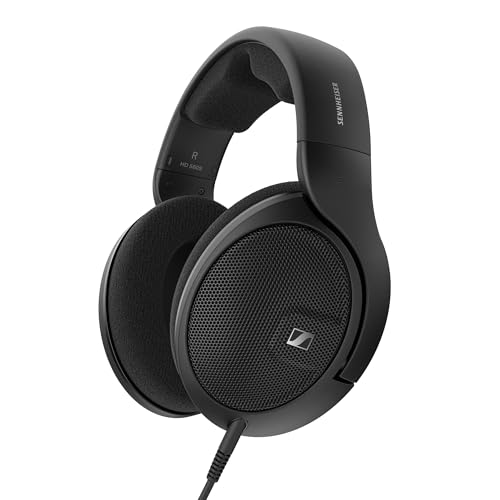
HD 560S
79% positive of 619 users
Budget gaming king with clear sound, but tight fit.


 AlexGFrank