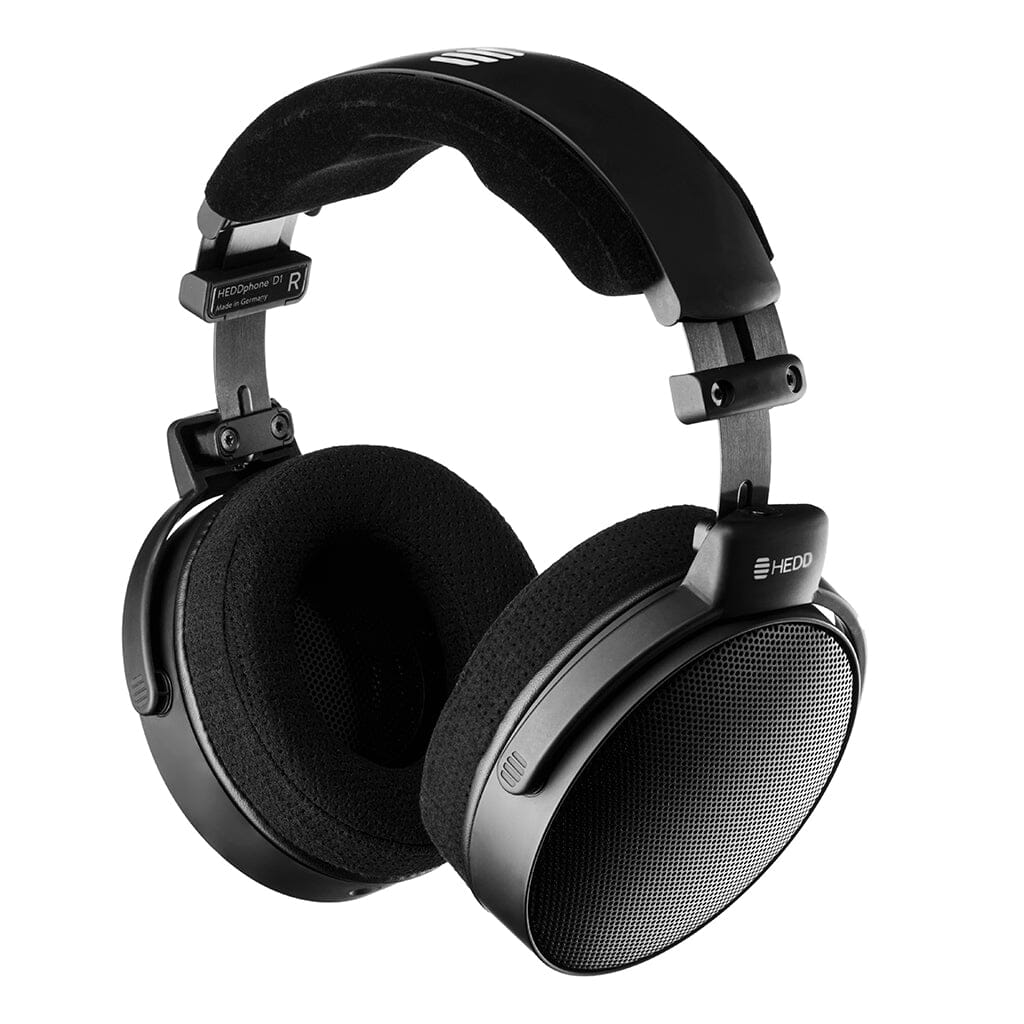
HEDD Audio HEDDphone D1

Running these analyses costs money. Buy through my links to help keep lights on! I may get a small commission.

Overall

#205 in

Headphones (Over / On Ear)

according to Reddit Icon Reddit

Sentiment score67% positive
20
5
5
Last updated: May 13, 2026

Reddit Reviews

Reddit Icona-by
3 months ago

Well, the 550 would only be a marginal upgrade over the 560s. You may be underwhelmed. I say, stretch your budget. Buy a Heddphone D1 and get a headphone that does everything. That's currently my top gaming pick, if only I could find one (perma sold out) [https://headphones.com/products/hedd-audio-d1-headphones?\_pos=1&\_psq=heddph&\_ss=e&\_v=1.0](https://headphones.com/products/hedd-audio-d1-headphones?_pos=1&_psq=heddph&_ss=e&_v=1.0)

Reddit IconAnnual_North_1776
4 months ago

Idk man, I have the focal clear mg pro, hd800s, elex, mv1 open and closed variants. I still reach for the D1. In my opinion the d1 is better than the hd800s.  And all others above, it just sounds great. detail is there, bass is nice and punchy but not bloated. More intimate for sure as the sound stage is good but not hd800s good.  I really love them, that being said the $700 ask is a pretty hard ask. The default headband padding is so bad. Im trying to mod it myself, dont like the caprah 3d printer they also look terrible. If they fix the headband padding and the creaking mine makes when moving maybe 700 isnt so bad. But as it stands I can't recommend them.  Almost forgot the earpads feel great but they're also kind of super cheaply made. Theyre standard pads with cut slits that you pull over the adapter, it looks terrible.  The foam in them also have way too much give they make my ears touch the driver. If I can fit the hifi comfort strap they'll be solid but thats more money I have to spend. Anyways sorry for the long paragraphs.

Reddit IconBackwoodsMarathon
4 months ago

I made a huge mistake buying the D1s. Once the stench dissipated, I don't think I've liked anything else more than the D1. I'm tempted to buy the HDB 630s next to replace my Maxwells as well. This hobby sucks. You think you're at end game and something else replaces your favorite gear.

Reddit Iconcacahahacaca
about 1 month ago

I sank a lot of money into a DCA E3 (sold a STAX 007mk2 setup to get it!), only to get the upgrade bug again and now I'm liking the much cheaper Heddphone D1 more than the E3. So don't assume that DCA is magical, either.

Reddit IconCAS30
3 months ago

I’ve been loving the HEDD HEDDphone D1 with the Meze Boom Mic. Been great for gaming and music.

Reddit IconDerrikMatusek
6 months ago

$179 in the past week. I wouldn’t buy them with the HD490 Pro being a thing now though. I have had both and just compared them side by side, the 490 Pro is just a better, easier to drive 600 series with actual bass potential.

Reddit IconDetritusHoarder
about 2 months ago

Quite funny seeing this thread now - I've had the 490s for a while and recently got the Kitharas to try out, partly because I fancied a change, saw all the praise for the Kitharas, but couldn't find that much direct comparison between them and the 490s (lots of Kithara vs all kinds of other brands and models of Sennheiser, not much vs 490 Pro). I spent a long time trying to gauge them objectively, and came to the same conclusion many do: Neither are outright "better". They have different design philosophies and traits and any areas they're better than each other are marginal - arguably the 490s have the edge on imaging, KItharas have the edge on detail because of those planars, and a few other tit-for-tat things. The Kitharas are certainly a great collab between Asus and Hifiman, it feels like what they came up with was better than the typical sum of their parts, hats off to the two of them for making a great product. However, except for when swapping between the two and immediately listening to exactly the same test, I was hard pressed to see benefit from either (and any other differences I had a preference for sound-wise I could just EQ out) - you almost certainly won't unless you're an esports pro min-maxing stuff, which you're probably not given you also want to listen to music on them :-) I'm ignoring a load of other things, e.g. Kithara has a mic and it's a bit of a fiddle to get a boom mic on the 490s; reputation of the vendors; repairability of the 490s; the weird headband tightness issue on the Kitharas (which is easily fixable); etc. etc. I initially decided to keep the Kitharas, but once I'd used them solidly for a few weeks I ended up returning them because of ergonomics: They are *heavy,* the cups are *big,* and the clamp force is light, which is an unfortunate combination. I have a big head, but if I leant to the side they'd clip my shoulder and shift, if I leant my head forwards or back they'd start sliding off. Don't underestimate the practical comfort of the 490s. The Kitharas also look goofy as all hell, but whatever. What did I end up keeping? The 490s, then I swapped those for some Heddphone D1s. They're an upgrade in sound (for my combo of preferences and use cases, but they really should be at nearly twice the price) and address the remaining niggles I had with the 490s. Endgame, for now :-) What would I recommend? Live with both for a week and put the others away. Sell/return the ones that you get on best with. There is no "better". Wiring: My desk is an Ikea Alex+Karlby combo, so I run a USB extension through the back of one of the taller drawers and keep the DAC (dongle not desktop, so I don't need to press buttons on it much/at all) and cans in there. When I'm using the headphones I grab them from the drawer and have the cable running through the gap at the front. It keeps the audio cable short, and I don't need to plug/unplug anything to get everything back to tidy.

Reddit IconGarlicBiscuits
3 months ago

I thought the Moondrop Cosmo was a very pleasant surprise when I owned them. I EQ the hell out of every headphone in my collection since I aim for HRTF-neutral sound, and the Cosmos were a rare exception that almost convinced me to not do so. I settled on the ZMF Caldera thick top-perf pads for them, and they were just very easygoing and non-fatiguing. There was a comfortable darkness that still allowed very good technical qualities to come through. Even nicer that simple bass and treble shelves (plus a 13khz reduction) allowed them to become that extra bit better. It's not surprising they reminded me a lot of my EQed Caldera Opens, though I find those still slightly edge out the Cosmos for a sense of timbral realism and revealing differences in how my music is produced. I could definitely see someone preferring the Cosmos though, mainly for being a bit softer and more relaxed. The other pleasant surprise recently has been the Hedd D1. My EQ adjustments for them were actually quite predictable, in that their FR follows my perceived HRTF dip/peak trends above 5khz very nicely. I essentially had to do nothing below 4khz besides a bass shelf. After those adjustments, they become the one open back dynamic that I think is roughly on equal grounds with planars. No big compromises in any one area, not even the subbass. My previous references for dynamics were the HD 800 and 2022 Focal Utopias, and I think the D1s are overall better than both, all after being EQed. Can't speak for the Austrian Audio Composer, but those also weren't as comfortable when I demoed them roughly two years ago. In general, I've found the $600-800 range to be ideal for headphones that are close enough to my more expensive favorites that one could be fully satisfied with them (mainly the HD 800 used, Cosmo, and D1). I imagine the Arya Stealth and Organic are in that same position for many folks, but Sennheiser and Hedd still seem to be preferable in terms of serviceability and longevity.

about 1 month ago

Not the OP, but I actually was planning to post my D1 review earlier today until I saw this one go up. Guess that means I should wait some time and make sure readers don't get fatigued from too much at once. To give my personal responses to your hesitations: 1) On my head, the D1's treble essentially does not change over the course of a session, at least not significantly enough to warrant changing my EQ profile for them. Said profile actually hasn't changed at all since dialing it in before my first session. If the sound does change, it would probably end up more of a wide-band, shelf-like change than anything related to adding peaks or dips. As long as you wear the D1s roughly the same way every time, I imagine you should expect a consistent and replicable response. 2) Boosting the subbass on the D1s does not interfere with the rest of its spectrum at all, and if anything, it only improves it. High-quality headphone bass should not significantly color the sound when it's boosted to, say, tilted diffuse-field neutral. Boosting the sub on an HD 600 series (and by extension, the 800 series) does seem to color the sound, which to me is indicative of physical limitations on the design level and what happens when you ask them to reproduce bass at an amplitude that they are not comfortable with reproducing. Distortion manifests as coloration of the tone, and the main way to know what that sounds like is hearing undistorted bass as a direct comparison. Whether that distortion is actually meaningful to your listening enjoyment is another thing (I am aware of the RTings study regarding that). With that said, I'm definitely excited to post my review here when the time feels right. I'll be offering a pretty different perspective on the D1s, and it's one that I hope people check out and think about on a deeper level. If you remember our conversation regarding the HD 800 in that other thread, a few of the points I brought up there will be relevant.

about 1 month ago

My review primarily talks about the D1s in its EQed form. That is part of the different perspective on offer, and whatever other headphones I may choose to review in the future will go by that same philosophy. I want to evaluate headphones in their subjectively ideal form (ideal being HRTF approximation) instead of in their stock forms since that's what gives me the clearest idea of fine-grain differences between them. For any readers who also want to go down that route, I want my experiences to give them my best possible idea of what they can expect once they've gotten good enough with EQ. What you ask does bring up a good consideration, ultimately. I will add at least one paragraph to my final draft and give some brief impressions of what the D1s most likely would have sounded like stock. Because I have them EQed so similarly to my HD 800 above 5khz, I have a strong idea what it would have been. I put them in the category of "EQ is not required, but you should still use it anyway to optimize their sound." The only other headphone I also classify as that is the DCA E3.

about 2 months ago

I definitely heard the HD 800 as a bit lean/thin on my head stock, but it was more of a warm-bright character than anything. 6khz peaks on graphs always show up at 5khz for me, so instead of getting a stock sound that came off shrill, it was just accentuated. Alongside that, they also exhibit elevations in other parts of the treble that I also tend to EQ down with other headphones (mainly 8khz and 11-13khz). These seem to be related to features of my diffuse-field HRTF. These colorations gave off the impression of the HD 800 being cleaner and more incisive than it really was in a roughly HRTF-neutral state, and EQing it out led to that realization. Interestingly, the EQ profile for my Hedd D1s is quite similar from 5khz up, yet that headphone's sound remains clean and precise across music instead of becoming softer and more diffuse. In case it's a helpful visual, here are my profiles for the HD 800 and D1 respectively. https://preview.redd.it/d0i18dezfxqg1.png?width=1344&format=png&auto=webp&s=098d7fed7ed029283deabfcbda993e14819c3889 The HD 800's bass is still more rolled off than what I hear as neutral since the headphone doesn't get the best seal even without my thin-armed glasses on, but it's adequate enough to support that soft/relaxed character. Crossfeed is also being applied before these filters, both for preference and to assist with getting a sine sweep that sounds roughly flat in volume. When you turn off crossfeed, sine sweeps sound like what I imagine my diffuse-field HRTF is (a conclusion I was delighted to see confirmed by the Headphone Show crew). Besides the bass, there's still wiggle room for a bit of human error since I do everything above 1khz by ear and by referencing multiple squig measurements. Nonetheless, I think I've gotten precise enough over time to be really satisfied with my results across my collection.

about 2 months ago

I have a long string of thoughts in relation to yours, so here goes. No pressure to reply. I use a combination of Squig measurements, Owliophile/szynalski, and music to optimize each of my headphones. Crossfeed used is the Jan Meier option in Equalizer APO/Peace, and in RootlessJamesDSP, the BS2B Weak option seems to be the equivalent. I specifically aim for tilted diffuse-field neutral with all of them rather than explicitly aiming for different sounds. Nonetheless, they still all end up sounding different with their broad behaviors in areas like transient definition, separation/layering, and even core tonal characteristics. Those first two are quite important for my preferences and main genre of choice (high-energy EDM that tends to utilize the entire sonic spectrum and reveals a good bit about any one headphone's subjective capabilities). While some degree of human error is still in there, I've been a steadfast believer that headphone sound reproduction still has heavy reliance on a given headphone's design and what it's doing to get a given frequency response to your eardrums. On one side of the coin, while it's certainly cool to see that the Headphone Show folks got an HD 600 to sound near-identical to an 800S after on-head measurements and EQ, there's a big caveat I imagine is easy to ignore. There is a very real possibility that those results are a consequence of comparing two Sennheisers that probably borrow a lot of acoustic research and design cues. In the broad headphone world, this crew could have found an *exception* that happens to coincide with their long-standing assumption of the rule (that rule being "it's all FR at the eardrum and openness"). It's too limited and similar a comparison pool to confirm that kind of sweeping conclusion. Try one of those Sennheisers EQed to your diffuse-field HRTF against an Audeze, DCA, ZMF, Focal, or any other brand EQed the same way, and in my mind, the chances of subjective differences popping up that aren't exclusively FR-related would increase notably. They're inevitably going to sound quite close, but it's the subtleties where they begin to branch out. My experiences have told me that none of my headphones after fine-grain EQ sound 100% like one another 100% of the time, even after considering factors like session-to-session mood, pad compression and wear, or placement variation. Human error is one element, but said collection also encompasses a wide array of brands that almost never design their headphones exactly like one another. I'll go back to the D1s as an anchor. One thing that might make its sound consistently clean and separated/layered to my ears would have to do with [the extensive research Composite Sound (the company that helped Hedd with development) had to exercise](https://www.composite-sound.com/technology/#Second-Generation-TPCD) to optimize the behavior of that headphone's diaphragm (increased control over its stiffness and motion) compared to other dynamic-cone transducers. What's being done with that driver would not only assist with the final FR (the D1s show an especially linear and predictable treble slope outside of HRTF features), but would also fare positively for the above aspects because that diaphragm was engineered to behave in a highly controlled (and accurate) manner. Allow me to put things further into perspective and introduce a couple trends. My EQ experiences have also found on the planar side that planars designed with increased tension via tighter control over the diaphragm (primarily Audezes and ZMF planars) tend to sound consistently clearer/cleaner, more incisive/less soft, more dynamic, and less diffuse than planars with more loosely tensioned diaphragms (like Moondrops and HiFiMans). Back on the dynamic driver side, the D1s fall neatly into the former camp, and the HD 800 would fall neatly into the latter. My preferences index more heavily for the former, so there is even an element of strategy to finding headphones with those kinds of design philosophies, though it's not super clear-cut. These are trends (among other examples) that our audiophile and audio enthusiast bubble could very well be looking into for additional variables regarding why we perceive sound the way we do, yet they are simply not being investigated. We're conditioned to only care about the final frequency response because it's treated as this immutable variable that more or less dictates headphone sound. Effective EQ can optimize phase, but it can't fix non-pistonic diaphragm behavior, pad bounce, standing waves, or other design-related cancellations, nor can it change how a given design is directing sound to your ears (such as via pad shape and magnet structure in the case of planars). You can't EQ the design you're working with. Additionally, like you said, we don't have an easy way of seeing these potential behavior differences in real time, nor is ABX blind-testing different headphones feasible when the topic of interest is behavior for that headphone specifically. Transposing its frequency response into another headphone as a means of comparison misses the point entirely. At the very least, I hope this direction, one that integrates science from other fields to fill in our current gaps, is the direction our space heads towards.

about 2 months ago

Yea, minimum phase is still one of the big things keeping what I say a bit hazy and difficult to maneuver around. Even then, it's still good to recognize examples of headphones that actually are out of phase in at least one area of their FRs for one reason or another. There are three examples that come to mind for me, two in the bass and one in the upper treble. 1. [The excess group delay for the Fosi i5, as measured by unheardlab](https://unheardlab.com/wp-content/uploads/2025/08/fosi-audio-i5-excess-group-delay.png?w=1500&h=), shows very unusual behavior in the bass below 100hz. Minimum phase headphones ordinarily show [an exponential rise in their curves as they go towards 20hz](https://www.audiosciencereview.com/forum/index.php?attachments/dan-clark-e3-closed-back-headphone-group-delay-response-measurement-png.330972/), but the i5 appears to exhibit the exact opposite behavior. Its curve is plummeting instead. I'm not sure what sound consequences this would have, but it's certainly an anomaly I haven't seen anywhere else. It sounds like it can happen with subwoofer systems. 2. This second one isn't plotted as excess group delay, but it was replicated with RTings' measurements of the same headphone (just a shame they now prevent you from viewing said measurements by default). I recall them saying the 2021 version of the Audeze LCD-X was out of phase by one wavelength in the subbass, and this also showed up with [Amir's normal group delay measurement](https://www.audiosciencereview.com/forum/index.php?attachments/audeze-lcd-x-measurements-group-delay-vs-frequency-response-2021-png.143665/). This is another case where audible effects are unclear, [but if the LCD-2s in my stable are anything to go by](https://diyaudioheaven.wordpress.com/wp-content/uploads/2021/06/gd-lcd2f.png), there's a chance this delay in subbass phase leads to an elevated sensation of density and meatiness in bass transients. Just a guess though, and if this is true, it would tag alongside the plunger effect from the completely closed front volume. 3. This last one is for a headphone I'm more intimately familiar with than anything I've ever owned: the ZMF Caldera Opens. They exhibit standing waves in the upper treble frequencies. This manifests as a series of extremely high-Q peaks and nulls through the treble ([see here and how it compares to the upcoming Tessidera](https://www.head-fi.org/threads/tessidera-the-new-euphonic-planar-from-zmf.979639/page-4#post-19038220), which effectively eliminates those waves through an acoustic lattice/matrix that helps diffuse backwaves out the wood cups in the back). The Atrium Damping System (ADS) already tried to minimize this, so it was clear some extra tech needed to be integrated for full effect. I could actually hear nulls shifting around on my head in sine sweeps every once in a while, and other times they weren't there at all. This behavior is further confirmed by [highly unusual group delay in the same band](https://www.audiosciencereview.com/forum/index.php?attachments/zmf-caldera-planar-magnetic-headphone-group-delay-response-measurements-png.330537/) (with everything else below being minimum phase), [alongside resonances in the CSD that clearly contradict the clean decay with a measured peak before that region](https://superbestaudiofriends.org/index.php?attachments/upload_2022-11-28_12-18-20-png.34057/). In actual listening and after EQ, the effects of these standing wave cancellations seem surprisingly subtle, yet I'm certain they have still permeated the Caldera Open's behavior in both highly positive and slightly negative ways. My previous comment on diaphragm-related trends still apply here, yet the COs still have a slight tinge of diffuseness, a slight softness and lushness, and a slight reduction in overall dynamism (that last one in comparison to something like the Audeze LCD-4zs). I always thought the COs were unusually unforgiving of muddy recordings as well, so these cancellations might have exacerbated those flaws. Despite the alleged effects of this narrow range, the Calderas have remained my favorite headphone for a reason. It's an objective flaw that has probably added to the music more than it has harmed it. Regarding your thoughts on hearing ability, I have a hunch that every one of us in this space is capable of "hearing through the FR" to try and get a taste for what a headphone is trying to do on the design level. Brain burn-in seems to serve as a notable effort to do this exact thing, and the closer you get to HRTF-neutral via EQ, the quicker/easier it is to perceptually tune out human-error-related colorations and hear how a given headphone is really behaving on a fundamental level. That's at least how I think about this, as my previous comment also explored. I also believe that you and other people are probably hearing broad differences between headphones that aren't exclusively tied to the FR, but it's difficult to *perceive* and *acknowledge* those differences as long as notable FR colorations continue to cloud assessment. It's just about impossible for me to agree with the idea that EQing so many different headphones to your diffuse-field HRTF makes them so close to identical that consumer choice comes down to aspects like price, build, and comfort. That probably can happen with edge cases like the HD 600 and 800 series, maybe even if you go the binaural head tracking route, but the former might still end up a rarity. I guess those kinds of conclusions are what happens when my preferences have become agonizingly specific, while most people like you will be perfectly satisfied with something that just sounds pleasing. Keep up that enjoyment if you can, as it's important to realize how few people my experiences will actually apply to. I'll leave it there (it's too late for me too), but it was nice just synthesizing my thoughts with you. 🤝

Rankings by Use Case

Top recommendations from others in the same boat

Other Reddit Recommendations: