Running these analyses costs money. Buy through my links to help keep lights on! I may get a small commission.
Reddit Reviews
 FinishOk8266
As a general rule, humidity spreads very easily in non-vacuum environments, especially in houses with HVAC systems, open floor plans, and normal air movement. In real homes, moisture doesn’t move by slow diffusion; it moves with air mixing (advection), which is why adjacent rooms often see a rise in RH when a portable humidifier is running in one space. That’s also why a portable unit can run nearly 24/7 without instantly over-humidifying a single room—the added moisture is constantly being diluted into the rest of the house. By contrast, a properly sized whole-house steam humidifier is controlled by a humidistat (either dedicated or built into the thermostat) and cannot run continuously. If a steam unit were allowed to run 24/7, it could easily drive indoor RH toward saturation, whereas recommended indoor RH generally tops out around 50–55% to avoid condensation and mold risk.
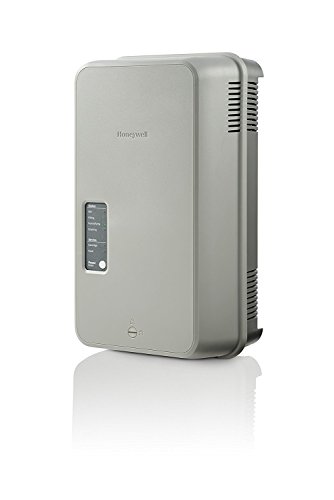
**Best option is a whole-house, steam humidifier**, (cold water) plumbed into the supply side of the of the pumping. stream of any salt - based softer, if applicable), with the main thermostat acting as the RH sensor and sending calls to the steam unit. Make sure thermostat window protection is enabled. Examples: **Aprilaire 800** or **Honeywell 750**. The Honeywell can run on **120V or 240V** depending on house size. Max output running 24/7 is roughly: * **5.5 GPD on 120V** * **11 GPD on 240V** Assuming decent insulation and ~9 ft ceilings: * **120V supports ~3,500 sq ft** * **240V supports ~7,000 sq ft** Whole-house steam is the only true *set-and-forget* solution. When outdoor temperatures drop, the system automatically limits indoor humidity—even if the humidity on thermostat is set higher—to prevent window condensation. This protects against water dripping into drywall and potential mold growth. Steam humidifiers are also safer and cleaner. The water is boiled (sterilized), minerals are left behind so you’re not breathing them (vaporized minerals aren’t great for lungs), and there’s no standing water for bacteria to grow. Passive HVAC humidifiers and room units are **not sterilized**. Room humidifiers are manual, hard to dial in l, adjstment, require frequent refilling (usually with distilled water), regular trips to buy heavy jugs, and frequent cleaning to avoid bacteria and mold. By comparison, a whole-house steam unit typically just needs a **cartridge replacement once a year**.
Steam is mainly about control and consistency. It actively generates vapor, so output isn’t tied to furnace runtime and it maintains target RH far more reliably in cold weather. Drip/bypass units like the Aprilaire 700 are cheaper to buy and run, but their effectiveness drops in cold conditions, they only work when the furnace is on, and evaporation leaves minerals behind—causing scale, frequent pad changes, and fine mineral dust entering the airstream, with the issue becoming worse as water hardness increases. Over long periods, inhaling fine particulates is associated with chronic airway irritation, can worsen asthma or other respiratory conditions, and may contribute to long-term lung function decline. Steam still needs maintenance, but it keeps minerals contained in the canister. Cost-wise, bypass units are roughly $20–$40 per season, while steam is closer to $100–$200. In many cold, dry climates, bypass units struggle to get past ~30% RH, while steam remains reliable.
Distilled water is strongly recommended for non-steam portable humidifiers, especially ultrasonic units, because minerals in tap water can be aerosolized and inhaled, and they also cause heavy mineral buildup. With evaporative (wick-based) units it’s less critical for air quality, but still helps reduce scale and frequent part replacement. For steam-based units, low-mineral water does reduce scale, but many electric steam humidifiers (especially electrode-type designs) actually require some mineral content for proper conductivity—using RO or fully distilled water can reduce efficiency, cause faults, or shorten unit life. Room-based steam units without disposable canisters also still have mold risk from standing water regardless of water type, and distilled water doesn’t eliminate the hassle of hauling jugs. That’s why whole-house steam systems are designed to contain minerals in a canister and keep them out of the air instead of relying on distilled water.
magnumsrtightI prefer the Honeywell advanced electrode humidifier HM750A. Maintenance service is simple - essentially a replacement electrode kit and easy to install.
TechnicalLeeHM750 would be sort of overkill for an apartment. You would also need to run a new dedicated circuit from your panel to the location (not sure if that is feasible). A 120V circuit would be plenty. The plenum design is also not optimal for steam dispersion, usually you want a several foot duct section with no branch ducts where the steam nozzle is located. If I was quoting this job, I would give you the option of Model 500 or the HM750 (provided there is a wire route to the panel), but the latter would be significantly more expensive. I will say there seems to be this impression out there that bypass humidifiers suck, and somehow fan is way better. In reality bypass and fan units are pretty close in performance (both depend on furnace runtime), and steam is the magic bullet. But steam is significantly more expensive and is sometimes difficult to install unless the electrical panel is nearby. It also usually has greater electricity costs (doesn't matter in your case since you have an electric furnace). Bypass will work just fine for 75% of installs. So I guess my point is bypass is sometimes all you need.
NeverTooMuchTechavoid ultrasonic unless you like white mineral deposits on everything. i like the Honeywell steam whole house humidifiers. and if you control them with a differential pressure switch, they can run whenever the primary hvac fan is blowing, not just when the thermostat is calling for heat.
svwerYes I have a Honeywell unit. Make sure your thermostat automatically adjusts based on outside temp or you will destroy your home. I'm not joking, I turned the feature off by mistake and went on vacation for a week. Inches of ice build up in the attic, doors, windows.
Unlikely_Property941Both April Aire and Honeywell work fine pick whichever fits your setup better. Main thing is your electrical steam units need more juice so check if your transformer and wiring can handle it before you start. Make sure there's a shutoff on the water line or add one. Taking the old one out without screwing up the ducts is the worst part so just take it slow there. Steam to steam swap isn't too bad though follow the instructions and don't rush it.
talonesthey are fine. If you have the ability to do the steam one its insanely good at getting moisture in the air and cost effective. The hot water loopback ones are pretty good, mine will keep my house maintained if I cycle the fan.
honestly, you want either a steam powered humidifier if you have the money and forced air to do it, or if you have to get something else, make sure its a HOT water humidifier. The ultrasonic humidifiers are pretty much useless in CO and waste a lot of energy. I have two Honeywell hot air humidifiers that can handle about 1000 sq ft each.
End of reviews