Maybe I'm in the minority, but my dual Nest Wifi Pro setup has been solid for me (minus random latency). I have them setup in a wired backhaul configuration. 50-60 device on the network at anyone time.
I've used both and honestly, I find the Eero to be faster and smoother and more consistent than when I had the Nest Wifi Pro 6E. I don't know if it's because my main router is the Max 7 but that's what I found.
The other thing I really like is you can mix and match the Eero routers, unlike Google's where you have swap out the entire mesh if you ever wanted to upgrade to their future devices (if any). Makes for a much easier and cheaper transition.
I'm a full Google ecosystem household with Android phones and nest hubs, but I still find my mesh network and all my smart devices, over 150 of them, run a lot smoother on the Eero network than on my previous Google network.
In regards to Matter, since I have a Nest Hub Max and a Nest Hub Audio, they both support matter and is therefore able to add Matter devices even if it's missing from the Eero network.
Eero Pro 6E has 2 ports. One is 2.5Gbps and the second one is 1Gbps. I have my Eero Pro 6E backhaul connected using a MoCA 2.5G adapter to connect it right to my main router, which is the Max 7.
I would not. I am currently replacing mine with ASUS mesh routers. The performance simply does not translate to the speeds you need from Wi-Fi. I pay for 1Gbps service and I get no more than 200 over Wi-Fi on any device. I have talked to support on and off for over a year about this issue to no avail. I simply would not waste your money on a product that Google does not support.
I hate to say it but I jumped ship after having to fight my nest pros for so long with just general functionality and having to invent workarounds to make them do normal routing tasks. I'm on ubiquiti now and never looking back.
**Setup:**
* Waoo fiber (Denmark) — Genexis fiber box confirmed in bridge mode by ISP
* Google Nest Wifi Pro (3 nodes): primary node wired to Genexis, living room hub on wired backhaul, 1st floor hub on wireless backhaul
* 3-floor house, \~270 m²
**The problem:**
I've spent a lot of time trying to fix persistent bufferbloat on my WiFi. After extensive troubleshooting I've isolated exactly where the problem sits. Here are the three key test results (Waveform bufferbloat test) – screenshots in first comment below.
**Grade A** – Direct Ethernet into Genexis box: 895/822 Mbps, +10ms / +3ms. The ISP line is perfect.
**Grade B** – Ethernet directly into Google Nest Wifi Pro primary node: 669/421 Mbps, +13ms / +49ms. Some bufferbloat introduced by Google's own NAT.
**Grade D** – WiFi via Google mesh: 456/324 Mbps, +55ms / +289ms. This is the daily experience.
**What I've already tried:**
* **GL-iNet GL-MT3000 (Beryl AX) with CAKE/SQM** placed between Genexis and Google – failed because Google Nest Wifi Pro insists on running in NAT mode when it detects an upstream router, creating double NAT. SQM can't reach Google's own buffers regardless of which interface it's applied to. Returned the device.
* **All Google Home advanced settings**: IPv6 off, WPA3 off, custom DNS (1.1.1.1) – no improvement.
* **Factory reset of primary node** while GL-MT3000 was upstream – Google still auto-sets to NAT mode, can't be overridden manually.
* **Physical optimization**: primary node in basement (short cable to Genexis), wired backhaul to living room hub.
**Conclusion:**
The ISP line and Genexis box are not the problem. The bottleneck is clearly Google Nest Wifi Pro's WiFi stack and NAT buffers. There is nothing left to configure in Google Home.
**Question:**
I'm ready to replace the Google mesh system and I want to get it right this time. What WiFi 6E mesh system would actually solve this for a 3-floor \~180 m² house? I have wired backhaul available for 2 of 3 nodes.
I've seen **Asus ZenWifi with Merlin firmware + CakeQoS** recommended for exactly this issue – is that the right move? Or are there other options worth considering?
Budget: \~3000–5000 DKK (\~$400–700 USD).
Never actually tried dedicated APs – I kept the Google nodes in place (they refused to go into AP mode and stayed in NAT, creating double NAT). I did try a GL-iNet GL-MT3000 with CAKE/SQM upstream, but that made things worse for the same reason.
Any router + AP recommendations? Budget \~$500–700, wired runs to basement and living room already in place.
Makes sense, unfortunately wiring isn't an option for me (no coax either). I have kids gaming in both the basement and on the 1st floor, so I'm dependent on WiFi delivering decent latency. Would dedicated APs still be a meaningful improvement over Google Nest Wifi Pro in that scenario?
Update on the coax wiring: went all detective after your reply and opened up some wiring that was boxed in (it's an old house). Looks like I have coax outlets on all floors but have no idea whether it's all connected properly. Thinking of buying this one and test it out. Makes sense? https://www.amazon.de/2-5-adapter-Ethernet-port-eksisterende-koaksialkabler-MA2500D/dp/B08XP8MMFG?source=ps-sl-shoppingads-lpcontext&ref_=fplfs&psc=1&shipTo=DK&language=da_DK&smid=A3VSQBVOUXDCX9
Top Mesh Wifi Systems on Reddit
1
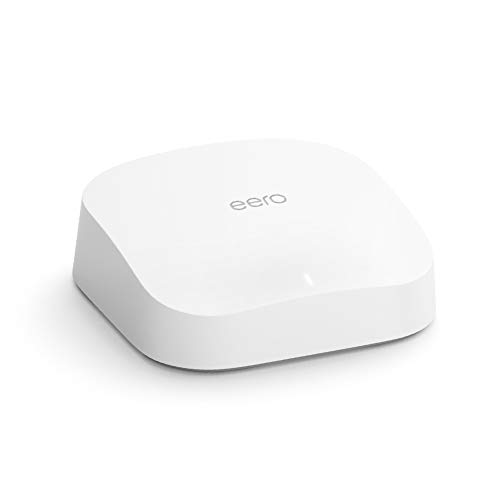
eero
Pro 6 Series
82% positive of 175 users
Easy, reliable, smart home ready; but paid features.


 ApatheticMoFo