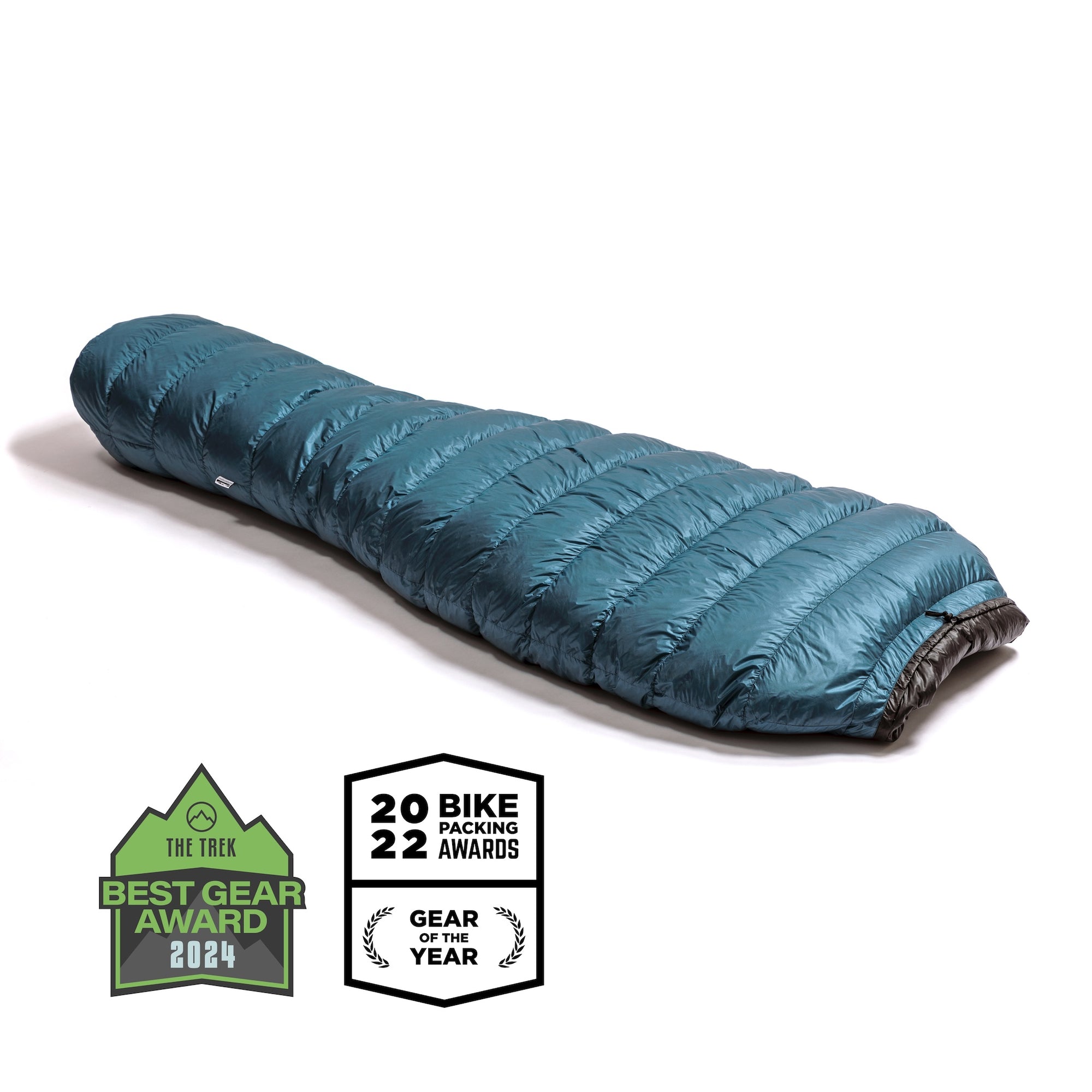
Western mountaineering Everlight mummy, 45 deg, about 3.5 L is a good reference. But I would not usually try to pack them that tight if I didn’t have to.
>I was absolutely freezing all night
>Current setup: 20° EE quilt
There’s your problem, read more below.
Others have said that your pad is the weak point, but at above freezing, it should have been adequate. However, if you are loosing heat to the ground, adding clothing layers really doesn’t help, so despite your seemingly overkill setup, the pad may in fact be the weak link. Otherwise (from a fellow cold sleeper) down pants make a huge difference for boosting the warmth of your sleep system.
I know EE quilts work for many people, but ignoring their racism, the design sucks and has several features that compound negatively unless conditions are close to ideal/you are lucky/you are extremely skilled:
-extremely long (12+ft) baffles that promote down shift and cold spots. Even if a baffle is perfectly filled there will be some down movement, and the larger the baffle, the larger this cold spot will be. Also, the U-shaped baffles are a straight up cost cutting decision since there are less chambers to fill (the high price does not reflect this).
-no differential cut. Differential cut (smaller inner fabric, larger outer fabric) helps maintain the 3D shape of baffles and stabilizes down. No diff cut plus super long baffles equals even worse performance (unless down is perfectly distributed and stays that way).
-limit rated. Quilt will sleep colder / be heavier than expected. Granted many makers use limit rating, but the best regarded ones don’t. Limit rating plus no diff cut plus long baffles equals bad performance.
FWIW, I have a 20°F EE quilt and a 20°F WM bag. The bag sleeps true to the rating while the quilt looks like a straight up piece of crap next to it. Based on the performance and specs, I estimate I would have to upgrade to a 0°F quilt plus hood to get the same performance as the WM bag, but the quilt will be *heavier*, only $30 cheaper and still have all the bad design choices mentioned above.
Others have already mentioned EEs problematic position regarding racism and fascism, but you also need to keep in mind that their quilt design (even though it might work fine for some) objectively sucks:
-super long U-shaped baffles that promote down migration and cold spots
-no differential cut (differential cut helps stabilize the shape of the baffles and boosts performance
-no edge tension control (elastic around the quilt opening to minimize drafts
-limit rated, meaning they are not as warm or light as the appear
-expensive considering the above points
Note that I have a 20°F EE Enigma and a 20°F WM bag. The WM bag makes the EE quilt look like a straight up piece of crap. I estimate that to get equivalent performance, you would have to go with a 0°F EE quilt plus dedicated head insulation; by that point WM is only like 30$ more expensive, WM is actually lighter, and EE still has a crap design.
I used a Western Moubtaineering -20F bag for Denali and Aconcagua. I would add a 0F bag to my quiver if I had unlimited money. Groundpad(s) are super important as you can lose a majority of the heat to the ground.
For legs, you need a puffy pair of pants when temps drop below -10F. They don’t have to be down, but needs puffiness
I used 8000m boots for Denali and glad I had them since temps were -30F and the wind was howling. I would have frostbite with anything less insulated. For Aconcagua, I used non-technical insulated boots that were light and warm and cheap. They would be awful on steep icy slopes, but not an issue on that peak.
I usually wear cotton socks. Wool socks never made too much of a difference in an insulate boot and gave less room for me to wiggle my toes. Toe wiggling is important to prevent frostbite.
You probably want to target about 45 pound weight max for your pack. Take a look at weight savings vs upgrades.
There are some cheap upgrades like a smart water bottle instead of the Nalgene. Nitecore NU20 or 25 headlamps are awesome.
Other upgrades are expensive. So much depends if this is just a one time adventure, or if you plan to do more mountains. If it is one time, look for what is on sale. If you are seriously getting back into it, Western Mountaineering sleeping bags are the best. Something like this is a reasonable sub-3lb choice: https://www.steepandcheap.com/rab-neutrino-pro-700-sleeping-bag
Definitely upgrade the pack. That is my least favorite pack I have ever used.
Western Mountaineering, Feathered Friends or Marmot for bags. Enlightened Equipment, Hammock Gear or Katabatic for backpacking quilts. Not cheap but quality and comfortable.
I've been a quilt user for years, but if I were looking for sleeping bags, I would go with either Western Mountaineering or Feathered Friends. You absolutely get what you pay for with either brand. Awesome quality.
Good pad. Stick with that.
Edit: (I forgot about the Nemo eclipse. That's something to look at. I don't think they're ready to ship yet. I don't know that factually. I think they're officially going on sale in march. REI was doing pre-orders.)
Someone mentioned Western Mountaineering. That's the best. But they're expensive. I don't know if I'd recommend it for a beginner. I have one and it's totally worth it. If you know you're going to be out there, then maybe eventually you want to make that investment.
In general about sleeping bags look at the EN or ISO Comfort rating. If they don't have that, you probably don't want it. That's an incorrect statement. Because even some top brands don't necessarily publish that for certain bags. In which case you just really need to look deeper into that bag. To give you a specific example, Western Mountaineering has EN number is published on a chart under their faqs. But that only goes down to their bags that are about zero rated and above. That doesn't mean that they're cold weather bags are crap. The exact opposite actually. But a lot of budget brands are throwing a temperature rating on there that may be more related to the extreme limit number which is survivability and you'll just be cold. If you want to look at the difference between the comfort, limit, and extreme limit rating, you can. But just stick with comfort. Maybe build in an extra 10° from what you actually expect to sleep in.
That's a heavy tent. You can save a lot of weight there. Let me offer a specific alternative. Durston Xmid 2. It's a trekking pole tent. If you wanted to try trekking poles, this is a great way to save weight. If you don't want to use trekking poles, Durston sells ZFlicks poles. You'll still be significantly lighter than the Half dome 2.
R/durstongearheads
Naturehike is a budget brand with tents you can look at to see if one would work for you. You'd save money. And probably can come out a fair amount lighter.
Check out r/ultralight. I'm not saying you should go full ultralight. But if you're going to be backpacking, save weight where you can.
Western Mountaineering has sleeping bags that you can order with one being right zip and one being left zip. And then you just zip them together.
But I'm going to be honest. I don't know your friends and family. That's not something I would put on a wedding registry. And I don't mean I wouldn't put sleeping bags on there. I wouldn't put Western Mountaineering on there because it's so freaking expensive. I have one. I bought it for myself. I'm okay with that. I'm just saying I wouldn't ask anybody else any kind of obligated way like a wedding registry to spend that much money on me.
What I'm seeing from the comments is that there are probably other brands that can do this. I just don't have a more affordable specific recommendation. So a little research might turn up a good result. I know a lot of brands are going to use zippers from similar suppliers. But my sort of guess is that you'll be better off finding a brand where they specifically state their bags zip together and then get two from them that you know are compatible.
Top Outdoor Sleeping Bags on Reddit
1
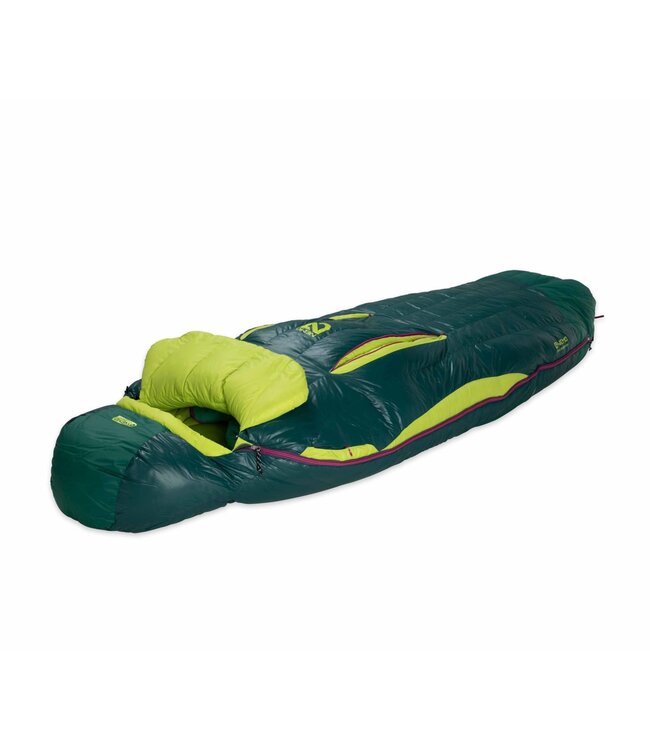
NEMO
Disco 15 Series
79% positive of 114 users
Spacious for side sleepers; bulky, temp rating optimistic.


 GenesOutside