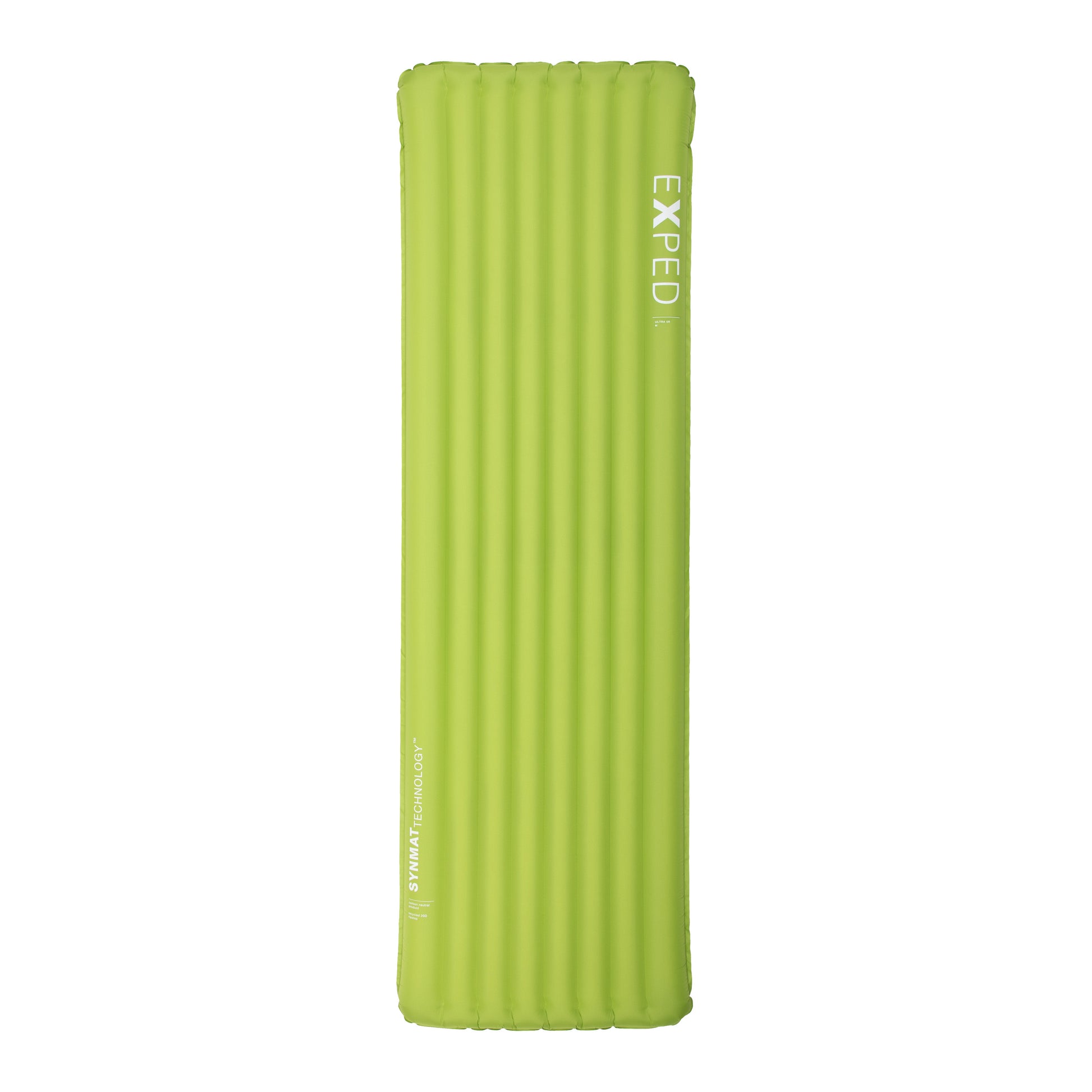
I'm 6'4" 360 lbs. I use this Teton sleeping pad [https://www.amazon.com/dp/B000P6DJ8O?th=1](https://www.amazon.com/dp/B000P6DJ8O?th=1) and/or a Therm-a-rest pad [https://www.amazon.com/dp/B00HANOZRY?th=1](https://www.amazon.com/dp/B00HANOZRY?th=1)
The Teton pad is not small, but if you are just setting up camp near your car they are great. The Term-a-rest rolls up small enough with my wool blanket to strap on to my backpack and is easy to carry around. It just isn't as comfortable alone.
[Exped FlexMat](https://www.exped.com/en/products/sleeping-mats/flexmat) and [FlexMat Plus](https://www.expedusa.com/products/flexmat-plus?variant=42267057029337)\* were available in LW size (77"x25"), now replaced by [Flex 1.5R](https://www.expedusa.com/products/flex-1-5r) and [Flex 3R](https://www.expedusa.com/products/flex-3r)\*, still in the same sizes.
[Thermarest RidgeRest](https://cascadedesigns.com/products/ridgerest-classic-sleeping-pad?variant=41316889657478) Large is also 77x25" inches.
[Seek Outside Matty McMatFace](https://seekoutside.com/matty-mcmat-face/) is 80x40".
[Gossamer Gear Thinlight Rolled Wide](https://www.gossamergear.com/products/thinlight-foam-pad?variant=42879197511734) is 58x25".
Mountain Laurel Design Goodnight is available in 80"x40" in both [1/8"](https://mountainlaureldesigns.com/product/goodnight-eva-1-8-foam-pad/) and [1/4"](https://mountainlaureldesigns.com/product/1-4-foam-pad/) EVA.
(\*) The FlexMat Plus has large dimples that some people dislike when new. They flatten some with use, or can be covered by a thin EVA pad (Thinlight/GoodNight/Matty McMatFace).
Um, take another look at my post. The second item is the Thermarest RidgeRest. It's popular for a reason (just maybe not *ultralight* reasons).
Thermarest also makes 23" wide pads in both CCF and self-inflating, like the ProLite series, for the military.
Speaking of this, [Alex Hibbert demonstrates using 5 layers of CCF for -40 weather](https://www.youtube.com/watch?v=mTP1ZcPXn8Q&t=282s). It's an older vid from the same guy that BigRob mentions, but it's more directly actionable since Alex has not finished designing his new system yet.
It can be done, and there are some reasons to do it, but "lightest weight" isn't one of them. For weight and bulk, air pads win. As Alex points out, one of the features of inflatables is that they can "uninflate", which is an issue where he's going. But he's a bit north of the PCT...
As MoonSandals suggests, you're going to have to do more testing for yourself. It's not super complicated: just add layers until you're comfortable.
Some noteworthy pads to consider:
* [Exped FlexMat Plus](https://www.expedusa.com/products/flexmat-plus) (thickest accordion-style pad due to large dimples). Some people like to use a flat topper over this pad.
* [Nunatak EvaZote](https://nunatakusa.com/59-ccf-sleeping-pads-genuine-evazote) (high density version of smooth roll-up pads, available in several thicknesses).
* [Thermarest RidgeRest](https://cascadedesigns.com/products/ridgerest-classic-sleeping-pad) (thicker than most other roll-ups).
Pulk\*.
Alex skied half the length of Greenland (and back) in four months, unsupported. That's the ultimate in "ultralight backpacking", but not the way we usually think of on major trails with towns every few days.
[Longest Unsupported Polar Arctic Journey in History: story of world-record 'Long Haul' expedition 4K - YouTube](https://www.youtube.com/watch?v=-dfrNqPwVgo)
(\*) CCF is bulky but not especially heavy. If necessary, you could strap more than one to a backpack without shifting the balance.
Maybe. I recently got an Exped and a RidgeRest to try as a pair, similar to what you describe. They are comfortable enough on the floor, but I haven't tested on roots and rocks yet. The Exped pad is available in a wider width than most other accordion pads.
just a heads up - the Exped 3R is an inflatable pad, not CCF. if you specifically want closed cell foam, the RidgeRest Classic is the way to go from those two. if you're open to inflatables though, the Exped is way more comfortable for side sleeping since CCF pads are pretty thin and firm.
both are solid options, but if width is key, the Ridgecrest classic might be a better bet for comfort. just make sure to check the R-value too for those chilly nights out!
The thermodynamic properties of CCF have nothing to do with name brands- it's just about the density of the foam, and the shape its cast in. Comfort, weight, and warmth are going to have a triangular relationship.
CCF is weight-competitive with inflatables up to about R4, which may or may not be an option for your use case depending on your personal needs. If you want an R4 foam pad, check out Oware's 1/2" thick CCF pads. It will be bulkier and less comfortable than a Z-Lite, but if you cut their 80" pad down to the standard 72", you'll come in at about 14oz, which is about the same as a NeoAir X-Lite. If you're shorter or taller than average, the fact that you can cut it to the exact length you need is a bonus.
Any warmer than R4, and an inflatable is going to be better in terms of warmth-to-weight. At that point, it's worth it to go for an R7-8 pad and use the increased bottom insulation to go a little lighter on your quilt, as each oz of extra weight you pay for the pad makes it 10F warmer compared to about 3 oz. of down for top insulation. (This tradeoff obviously has limits, but works for a difference of about 10-20F in most cases.)
>R-4 for that half inch? Color me skeptical…
It's not a bold claim. The insulation of CCF is directly proportional to its thickness when compressed under load. There's not much "technology" going on.
Thermarest claims the Z-lite is ".75 in. thick" but most of that style of pad is actually 1/4" foam, cast into an egg-crate design that compresses flat when you lay on it so it's more comfortable. (That's why 14 layers of it are only 5 inches high when stacked)
The Oware pad is *solid* 1/2" foam that doesn't really compress much when you lay on it, so it's essentially as warm as two Z-Lites stacked. (But as I said, this also means it's firmer and less comfortable.)
No, high-quality CCF is about R7 per inch, without a radiant reflector.
A Z-lite is 1/4" thick when compressed and R2. If that claim is accurate, a 1/2" solid CCF pad should come in at or close to R4. Oware claims that's about accurate.
I'm getting my values from professional insulation contractors. Where are yours from?
>Check the ridgerest
>
Much softer foam.
Edit: Calling me "simply incorrect" and then blocking me without sourcing your information is not very convincing.
It's always going to be ball-park and results are always going to vary with environmental factors that are hard to control for, personal sleep experience, and sleep system proficiency, but I can report anecdotally that my quilt is *definitely* comfortable at lower temperatures on my wife's 8.5R Tensor Extreme than on my older R4.5 Tensor Insulated. As in, I was woken up by cold at 12F in a 10F HG Burrow, switched pads with my wife (who sleeps warmer than I do) and was pretty much immediately toasty warm and slept comfortably until morning. That's about as close to a controlled result as I can get on the trail.
Her pad was only 3oz heavier than mine, and if you had put me back on my pad and added 3oz of down and the accompanying loft (which is about the difference in weight between a 10F and 0F), I doubt I would have been anywhere near as comfortable. I also noticed that I couldn't tell from *how* I felt cold that it was specifically the pad that was the weak link. It's wasn't like my back felt specifically cold. But it clearly WAS the pad.
There is obviously going to be an intersection where the quilt's heat loss dominates over conductive loss to the ground and the pad's rating becomes wasteful. I don't think you can be comfortable in a summer quilt on a high-R pad at freezing temps or anything. But I personally believe that most UL hikers overestimate the quilt's impact, skimp on their pad, and use less size- and weight-efficient systems than they could be using.
Top Sleeping Pads on Reddit
1
Exped
MegaMat Series
92% positive of 454 users
Car camping comfort champ, but some side sleepers find it thin.



 Chadarius