ASUS Routers with [Merlin firmware](https://www.asuswrt-merlin.net) have been solid for me for over a decade with hundreds of devices connected in large footprint, multi-story situations. Pretty much anything you cannot do by default, there is an add-on for or you can create your own custom add-ons.
Started with an RT-5300 and eventually moved to RT-AX86U and then GT-AXE16000 using the RT-AX86U’s as Mesh Network APs just for fun.
For new construction or huge footprint office/hotel I might go with UnfiFi, but to cover the same footprint as my ASUS covers would have been a lot of equipment to do the same thing. Not dogging UniFi, it’s great at what it does, but it’s expensively split up hardware and, at least when I looked at it last time, not nearly as customizable.
flint 2 is better , flint3 seems like a down grade, i personally had the ax86u and just now use it as a node, main is axe16000
https://preview.redd.it/1pg79cu7xcvf1.jpeg?width=1200&format=pjpg&auto=webp&s=8ad53ab8bca885e17aea6787c810fbc85c93254d
I’ve always had Asus routers with my recent being the AXE 16000. As a result it seemed logical for me if I wanted a mesh system to go the AImesh route. I purchased an extra couple of ASUS routers and to be honest found the speeds to be disappointing and found that the extra routers were often disconnecting. As a result I moved to a TP link Deco system and have been incredibly impressed particularly with maintaining my internets full gigabit speeds between nodes. I know some people go on about how managing the system is app only but personally I actually find that more convenient, but then maybe I don’t tinker enough with the system to require more access than that, apart from changing a few DNS settings.
Yes. It's GREAT on paper, but doesn't perform well at all. Coverage is terrible and speeds are abysmal, even in the same room. Yes, I've optimized the channels. ISP router performs better side by side.
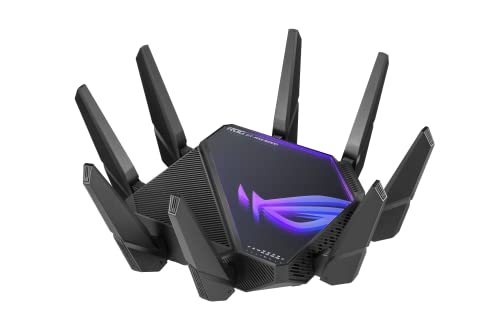
[https://www.amazon.com/dp/B09Z792WWF](https://www.amazon.com/dp/B09Z792WWF) (ASUS ROG Rapture WiFi 6E Gaming Router (GT-AXE16000)
I had issues with wifi, tried wifi 7/MLO, then went back to wifi 5 (and wifi 6E for my cell phone). This thing has two wifi 5 networks. If you need to punch thru like 3 walls, wifi 5 is what you need. I have done extensive research into this ;-D You don't need to get this exact router (I use as AP only), but you want a high power wifi 5 if you struggle with connectivity range in order to punch thru the walls. (2 is good, because you can use one for your main PC/gaming PC), so there is no other traffic competing for bandwidth) I actually got this router for half price, because amazon offered me (and maybe you) half the value of this item if you just sign up for a credit card (you don't need to use it and it's instant payout). You can get this or w/e for half off basically. This works for a bunch of items, but only once ;-D (It support asus-merlinwrt and openwrt)
Funny that this is marketed as a gaming router, but the strength of this router is in a high wireless / wifi dense environment. I run over 80 smart devices on my home network and am currently using an ASUS GT-AXE16000 which is the first router I have had that handled this dense of wifi devices without hickups and kicking devices off the network at times.
Also, I want the AI for the security handling. I am sure that China is using AI to hack into systems now so it will take AI to battle AI. We are in a chess game for network security. I want this router but the last thing I want it in is white. Nothing degrades over time faster than white plastic. It needed to be in black. Until they have a black options I am holding off buying it. I have seen it in the UAE in black so I know it is being made with that option so I do not understand why it is not being sold in the USA that way.
Top WiFi Routers on Reddit
1
GL.iNet
GL-MT6000 (Flint 2)
91% positive of 197 users
OpenWrt enthusiast's choice; good value, but lacks 6GHz.


 Ayitaka