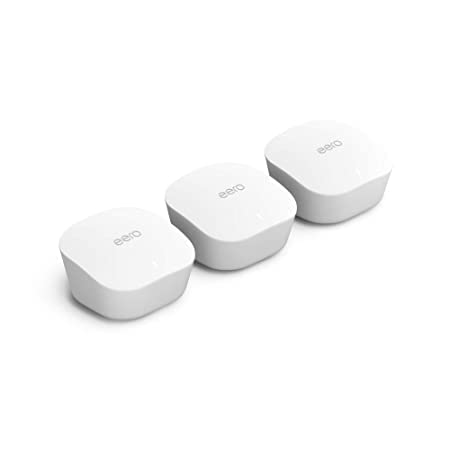
For mesh I like EERO. They also have 5 years of updates past when they discontinue an item. For example they are on the EERO 7. The EERO 2 is currently going for like 40 bucks on eBay and the updates are until 2030.
Yes, updating to a meshed solution will ensure smooth roaming throughout your house.
I like the Eeros for two reasons:
1. It’s set and forget. There is very good logic built into it to better manage your airspace.
2. It’s compatible with all other generations of Eeors. Find a dead spot? Get a cheap, used Eero five from Facebook marketplace.
As others have said, use ethernet wiring where you can. Between nodes and to individual devices. The reason being a wireless device looses 50% of available bandwidth for each wireless hop it takes to your Verizon router. Would you notice it on your cell phone? Probably not. Running a media server or gaming platform, probably so.
We put in an eero 5 a few years ago and have been very happy with it. But our house is wired for Ethernet, so we have wired hackhaul. If you don't have Ethernet, but do have coax, you could use MoCA to achieve the same thing. It's a bit pricey, but it's a one time expense.
Yeah, I wish this was made clearer. And you’re sort of stuck if you can’t upgrade your router.
EERO has a router that’s bundled with the Ring security system, so it’s all literally one piece of hardware so I can’t get rid of my router without ditching the security system that otherwise works great for me.
It’s really kept me from playing because I don’t know if it’ll be a “good” or “bad” router day.
Personally, I don't think the privacy fair is a big deal in the Asus. You don't actually have to use the AI protection (which is the trend micro part) and honestly you probably don't need to, given what you're describing. However, there may be sometime better:
"Not looking for poweruser/enterprise solutions, just something that works out of the box for heavy normie use."
Your use case is literally what Eero is made for. It's now owned by Amazon and just works out of the box--and works really well. The downside? You can't do very much power user/Enterprise things.
I have been struggling with Asus Wi-Fi for a few years and bought the Eero's on a black Friday sale to try. I get great signal strength everywhere I need it, and then some. I'm only frustrated with it, because I do need/want power user features. However I am debating just letting it be, because it works so well. You'll probably be ok with just one Eero unit, but you can always add super easily down the road, if you need to. With one LAN device, you're covered with one Eero. Any more on top of that, and you'll also need a cheap switch to add ports. Look at either the Eero 7 or Eero 7 Pro. Good luck!
If you're looking at mainstream consumer cameras, yes. Unifi had the added benefit of also being able to directly manage and save video feeds from prosumer cameras that can run locally. I'll also second that you don't need to worry about complexity with Unifi. It can be straightforward unless (or until someday you decide) you want more complexity. It will grow with you.
Edit to add that Eero is definitely the easiest to setup/deploy, but comes at a high price point with limitations that you may not like down the road. You can only temporarily restrict radio bands (2.4/5 GHz). You can't have more than one primary, and one guest network. You also have to pay for many security features or network monitoring features. With Unifi, you can start with perhaps their UDR7 as a combo gateway/access point, and expand with an many U7 Lites or similar, if you find you need more coverage. That might work out cheaper than the Eero, depending on what area you're trying to cover.
Top WiFi Routers on Reddit
1
GL.iNet
GL-MT6000 (Flint 2)
91% positive of 197 users
OpenWrt enthusiast's choice; good value, but lacks 6GHz.


 Airborne_Acorn